Public Policy Memo

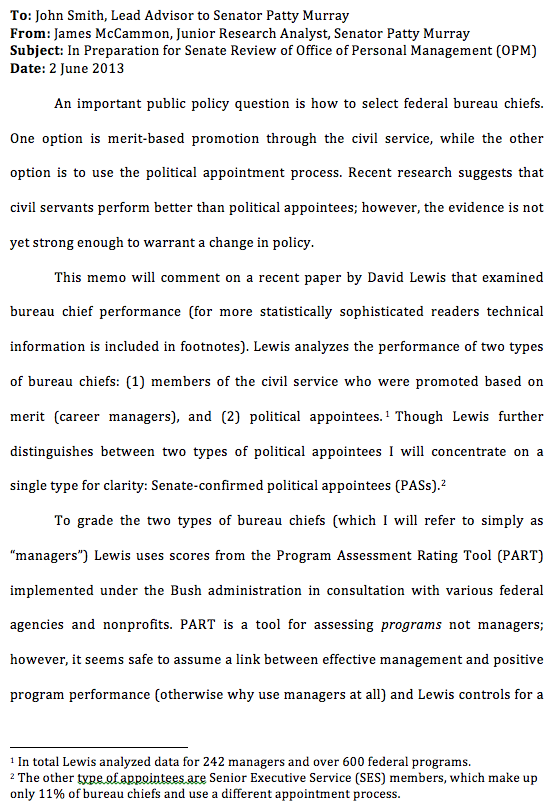
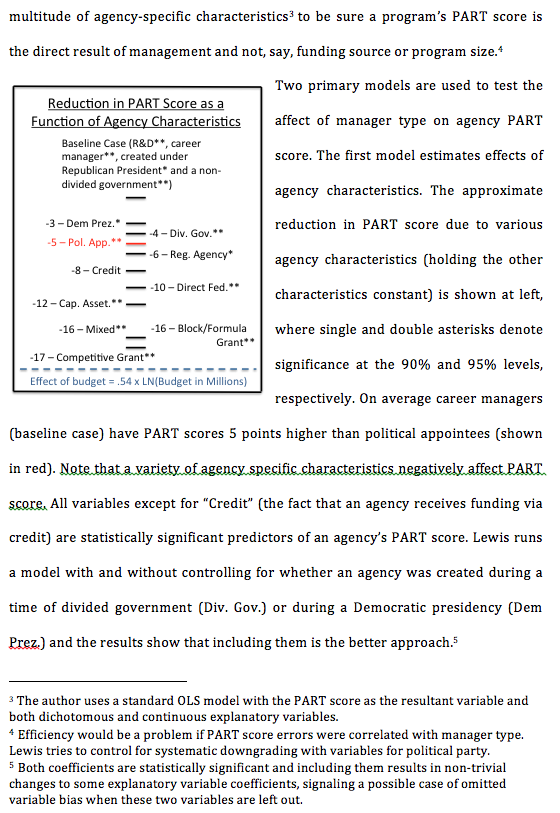
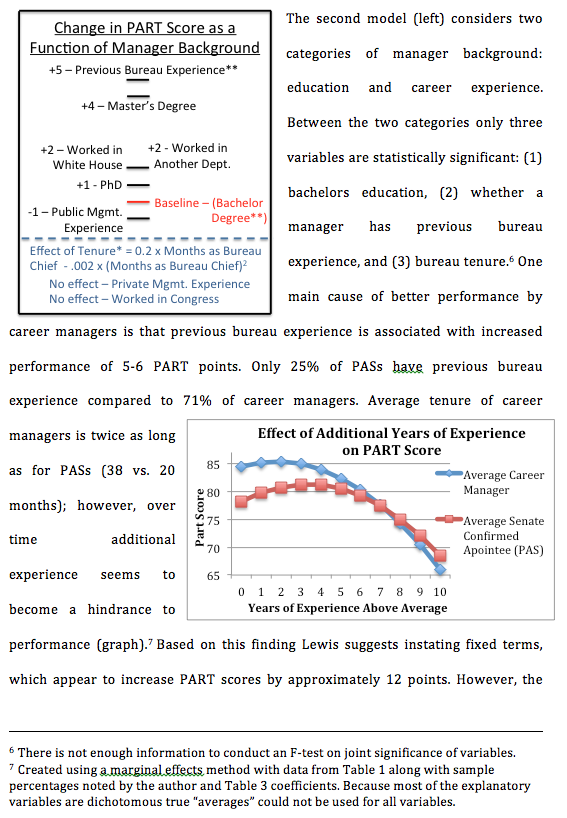
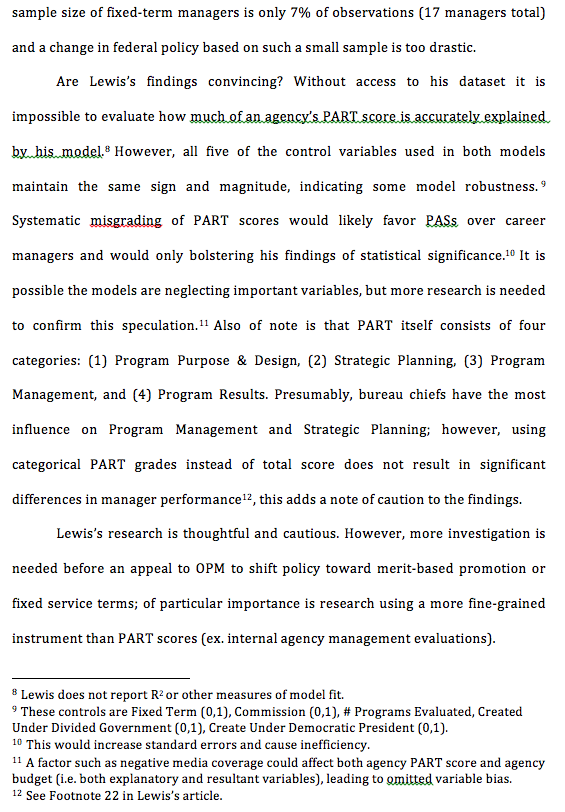
This is a memo I wrote as part of a public policy class focusing on regression methods and analysis. My professor thought it was good overall, but that I should’ve simplified my diagrams and message. Probably correct. Of course, it’s the first memo I’ve written so bumps are to be expected.

The assignment was to play junior analyst and present the results of a David Lewis paper to a party of our choosing. I don’t remember what paper it was precisely, much of his work is centered around the question of political appointees and performance.

Screen Shot 2014-04-05 at 11.58.34 PM

Screen Shot 2014-04-05 at 11.59.18 PM

Screen Shot 2014-04-06 at 12.00.16 AM

Screen Shot 2014-04-06 at 12.00.36 AM

Welcome to My Homepage!

Welcome to my homepage. I started this site to be a sort of online resume – a repository for my coding and design work so that potential employers can see my value first hand. I’m currently a master’s student at the University of Washington. My home department is the Jackson School of International Studies, but I’ve taken many graduate classes in other departments (mainly public affairs and statistics). I start a new data analysis job in late June. Feel free to follow the links below or browse around!

Find out about more about me…like as a person ‘n’ stuff.

For my more traditional resume click here.

Skills:

R

For examples of my R programing work go here.
Classes: (1) Applied Regression, (2) Nonparametric Regression (in progress), (3) Statistical Computing (in progress). All three were graduate statistics courses.
Projects: NBA Data Analysis (ongoing). I used R’s XML and RCurl packages to scrape several websites using a variety of techniques.

Stata

For examples of my Stata programing work go here.
Classes: (1) Basic Linear Regression and (2) Survey of Regression Techniques (IV, Regression Discontinuity, Difference-in-Difference, etc.), which were both offered by the School of Public Affairs; (3) Correlated Data (in progress) from the Department of Biostatistics.
Projects: I completed a semi-supervised 2-credit analysis of World Bank data using Stata. The project involved merging many .dta files, creating and concatenating variables, and running a series of bootstrapped logistic regressions using the Clarify library.

C

For examples of my C work go here (in progress, coming soon).
Classes: All of my C work was done in Statistical Computing (Statistics Department).

Microsoft Access & SQL

For examples of Microsoft Access work go here.
Classes: (1) Database Concepts (Information School). I completed the entire 600-page GO! Microsoft Access Comprehensive textbook. I’ve enrolled in a certificate program in database management this summer, which will include 100 hours of instruction. There is a strong SQL component to the course.

Excel

For examples of my Excel work go here (more to come).
Classes: Excel modeling, an upper-division undergraduate business school class in the quantitative methods department.

Adobe Illustrator and InDesign

For examples of my design work go here.
I learned Illustrator and InDesign last summer to improve the look and feel of my thesis. I’ve come to really love design so I play around a lot in Illustrator for fun.

Research and Writing

Check out some of the papers below for samples of my research, writing, and analysis skills.

Matlab

Classes: I took Beginning Scientific Computing (taught in Matlab) from the Department of Applied Math two years ago. My skills are somewhat rusty and I prefer R, but I do have some Matlab knowledge.

LaTeX

Nothing to complicated here, but still a nice skill to have. For examples of my LaTeX work go here.

International Cooperation and A Post-Kyoto Regime: Participation, Problems, and Promise

Abstract

In 2005 the Kyoto Protocol went into effect, a product of the United Nations Framework Convention on Climate Change (UNFCCC). Despite its alleged success, Kyoto suffered from various shortfalls including no dispute resolution system and an exemption of the world’s developing nations. Kyoto is set to expire in 2012 and there have been continued negotiations aimed at creating a post-Kyoto regime. Yet despite continued dialogue there has been negligible progress toward meaningful agreement that would significantly reduce world greenhouse gas emissions. What can explain the lack of international agreement on climate change? This question will be analyzed using three alternative international relations frameworks: relative gains theory, republican liberalism, and neoliberal institutionalism. Relative gains theory posits that states act strategically to maximize their gains relative to other nations. Though applicable to particular countries participating in negotiations, this theory fails to recognize the inherent difficulty in making such calculations when considering complex and ambiguous problems such as climate change. Republican liberalism explains state action by studying interactions between domestic interest groups and national governments and theorizes that these complex relationships then manifest at the state level. While initially appealing, this theory ultimately fails to be adequate in dealing with problems at the international system level. Lastly, neoliberal institutionalism will be considered. This approach is primarily concerned with supranational institutions and provides a set of predictions that have largely come to fruition between states negotiating a post-Kyoto agreement.

Introduction

For over a decade long-term climate change has been one of the most important topics for governments of both rich and poor countries alike. For instance, in a recent survey by the World Economic Forum climate change ranked as one of the issues with the highest aggregate score of both current governmental concern and potential global impact. Yet despite persistent rhetoric about rising sea levels, displaced populations, and widespread crop failure the global community has made little progress in the way of cooperation to stem the problem. What can explain this lack of international agreement on climate change? The question of this “dilemma of common aversion” will be examined using the Kyoto Protocol as a case study with special emphasis on the last four rounds of negotiation (since 2009) within the United Nations Framework Convention on Climate Change (UNFCCC).

Three alternative explanations will be discussed: relative gains theory, domestic explanations of political interest groups known as republican liberalism, and neoliberal intuitionalism. Relative gains theory is powerful at explaining some actors such as China, but fails as a universal explanation because of the difficulty of calculating gains for complex problems such as climate change. Republican liberalism offers important insights into the processes that determine state preference, but offers little predictive power or policy solutions at the global level. Neoliberal institutionalism, however, can adequately explain both the behavior of actors at a global level and provides powerful policy prescriptions that have already begun to materialize in the latest rounds of negotiations.

Background

Scientific interest in climate change has gone through several stages. There was, in fact, little interest in the subject at all in the first half of the twentieth century. From the 1950s forward concern gradually increased within the scientific community until the late 1970s when a consensus began to emerge. The first World Climate Conference convened in 1979 and it was in 1988 that the IPCC was founded as a joint venture between the World Meteorological Organization (WMO) and the United Nations Environmental Program (UNEP). In 1992 the United Nations Framework Convention on Climate Change was signed. The Convention was an international treaty meant to help stem increasing global surface temperatures and manage the impacts of change that did occur. It has since become a framework for annual climate meetings—so-called Conventions of the Parties (COPs)—the goal of which is to spawn further treaties that call for specific reductions, the Kyoto Protocol being the most notable. It emerged in Kyoto, Japan during the 3rd annual meeting of the UNFCCC in 1997.

Climate change has only gained further prominence in recent years. Al Gore and the IPCC shared the Nobel Peace Prize in 2007 for their environmental education efforts (The Nobel Foundation 2007); during the 2009 Copenhagen round of UNFCCC negotiations 15,000 delegates and 5,000 journalists attended (Bhagwati 2011); and in both the 2011 and 2012 World Economic Forum surveys of global risks, climate change ranked among the top in terms of both likelihood and impact (Tambourgi et al. 2012).

The Kyoto Protocol set reduction targets on six Greenhouse gases for 37 industrialized countries and the European Community (at the time consisting of 15 European countries now subsumed within the European Union). The reductions required for each country equate to an average of a 5% reduction below 1990 levels between the period 2008-2012. Whereas other types of pollution may be feared for harmful effects to humans directly, greenhouse gas emissions are threatening through their affects on surface temperature increases of air, water, and land masses. In “the most comprehensive modeling yet” (Chandler 2009) on the subject, a group at MIT published estimates of median surface warming of 5.2 degrees Celsius by 2010. The Intergovernmental Panel on Climate Change (IPCC) has projected a host of negative effects if temperatures continue to rise. These include increasing drought and water stress, increased plant and animal extinction, extensive coastal flooding, redistribution of fertile croplands, severe heat waves and storm patterns, and negative health impacts including malnutrition, cardio-respiratory problems, and infectious diseases (I.P.O.C. 2007).

At first glance the Kyoto Protocol seems to negate the central question of this paper—if there, in fact, has been global cooperation on climate change why is there an open question as to the nature of any alleged lack of international climate agreement? As the world’s first international treaty regulating climate change the important precedent set by Kyoto should be recognized. However, it should not be oversold. Kyoto was limited along several important dimensions that only further animates questions about global recalcitrance toward significant agreement.

First, Kyoto was mainly a treaty aimed at industrially developed nations. All developing countries were excluded from emissions restrictions including China, which has grown into the world’s largest greenhouse gas emitter. Second, Kyoto had limited enforcement power. The United States delegation during the Kyoto meeting signed the treaty, but after returning home the United States Congress refused ratification. The fact that the United States was at the time the largest greenhouse gas emitter only exacerbated the magnitude of the enforcement problem (the US is now second behind China). This enforcement problem also extents to violations of the protocol. In May of 2011 Russia, Japan, and Canada announced they would not join the Kyoto extension after the initial agreement expired in 2012 (The Sydney Morning Herald 2011) and in December Canada announced it would leave Kyoto altogether to avoid paying billions in fees (Austen 2011). Third, the agreement was of limited duration: the period between 2005 and 2012. It makes perfect sense to draft an agreement of limited length so that its goals and success can be reevaluated and updated as needed. Nevertheless, it only postpones wider agreement until 2012—an agreement that must now incorporate not only developed countries, but developing ones as well, to say nothing of the more stringent reductions now required if climate change is to be stemmed.

Clearly, then, this is a case of “anarchy” if we take the term to mean the absence of legitimate international government in the same way it exists in domestic politics—the usual definition employed in IR (see Waltz 1979, for example). This fact, however, merely creates a point of departure. That there is no central authority in global politics is a fact, not a theory. To what extent anarchy defines the actions of, and relations between, states is the heart of the matter and where important cleavages between theories emerge.

Three such approaches that take differing views on the prospects of anarchy will be discussed throughout the remainder of this paper. These three are relative gains theory, republican liberalism, and neoliberal institutionalism. Though not comprehensive of the entire field, these three IR theories offer the most compelling possible explanations concerning the lack of global agreement on climate change. What follows is an elaboration of each of these theories and its application to climate change. While each can explain some portion of the friction between countries, only neoliberal institutionalism can fully explain and predict current affairs.

Relative Gains

One result of anarchy might be that states maximize their relative power—the size of their slice of the pie rather than the size of the pie itself. Under this view State A would be perfectly willing to give up some power as long as State B lost more of its own power. “For sure, each state tries to maximize its absolute gains; still, it is more important for a state to make sure it does no worse, and perhaps better, than the other state in any agreement (Mearsheimer 2001, p. 68),” wrote theorist John Mearsheimer. Relative gains theory entails additional calculations since two different aspects of “pie growth” must be considered—the size of the pie and your slice of it. As a result, relative gains theory argues that “cooperation is more difficult to achieve…when states are attuned to relative gains rather than absolute gains (Mearsheimer, 2001, p. 68).” One possible explanation for a lack of climate agreement, therefore, is that states are reluctant to sign climate treaties because they fear relative losses.

To be clear, we must ask what “gains” and “losses” we have in mind. Climate change involves the weighing of current gains and losses in economic growth against a more amorphous calculation of potential future losses that differ by country, but likely includes economic, environmental, and citizen welfare considerations. The calculation is cofounded by the fact that the world is a global commons and as such greenhouse gases affect all countries roughly equally regardless of the country that originally released the gases.

Current reductions in greenhouse gas emissions are inextricably linked to economic growth. This is because CO2, the most prominent greenhouse gas, is mainly a product of transportation and energy sectors, which often compose significant portions of a nation’s economy. Government regulation to cut greenhouse gas emissions will necessarily need to take into account reductions in CO2, thus limiting transportation and energy sector growth and through this channel affecting overall GDP growth. Further, economic gains and losses are a direct channel to political power. As Robert Gilpin eloquently phrased it: “In a world in which power rests increasingly on economic and industrial capabilities, one cannot really distinguish between wealth…and power as national goals (Gilpin 1975).”

To be sure, particular countries are exhibiting some signs of relative gains calculations. China is one such example. Though it has often marketed itself as a 21st century economic powerhouse, when it comes to climate change agreement China has aligned with the developing countries of the Group of 77 (G77) (a group that actually includes 132 countries). For example, after the opening day of the talks in Durban, South Africa at the end of 2011, the G77 and China released a joint statement calling for meaningful progress during the talks (Executive Secretariat of the Group of 77 2011). While China continues to show modest per capita GDP, there is irony in the world’s second largest economy aligning with developing nations, many of which have economies orders of magnitude smaller than China (to say nothing of their comparison to sustained Chinese growth). By positioning itself as a developing country and mounting continued momentum toward the view that developing countries should receive aid and face more lenient emissions requirements, China stands to benefit from the subsidies of rich countries even as its own economy grows further ahead of those providing support.

Relative gains theory falls short when applied systematically, however. In addition to the challenges of weighing short-term economic security against uncertain global risk decades in the future, the calculation of relative gains is complicated further by the specific features of the Kyoto Protocol. Such features include the Clean Development Mechanism (CDM) that allows for investment of green energy projects in developing countries; Joint Implementation (JI), which enables developed countries to invest in each other in exchange for carbon credits; and Emissions Trading, a global carbon credit trading market. Such interconnectedness makes it difficult to predict what strategies particular countries will favor over the long run and thus which states stand to gain in relation to others.

A deeper analysis of UNFCCC negotiations reveals that there is significant state action operating outside of relative gains calculations. It is clear that a variety of institutional pressures and norms have developed that guide state action to particular ends. The details of these features will be taken up when discussing neoliberal institutionalism.

Republican Liberalism

A second theory that can be directed toward explaining the lack of climate change agreement is republican liberalism. This theory posits that state action is simply a manifestation of domestic interests. It “emphasizes the ways in which domestic institutions and practices aggregate…transforming them into state policy. The key variable… [is] whose social preferences dominate state policy [emphasis original] (Reus-Smit 2008, p. 244).” The theory studies governing coalitions, regulatory capture, unions, lobbyists, administrators and others who affect and determine foreign policy.

There is a lot to like about republican liberalism, starting with the fact that the theory is an articulation of what is obvious: states are artificial and abstract conceptions. In practical terms it means nothing to say that “China” signed a treaty. “China” has no hands. What we mean when we say “China signed” is that some Chinese official was sent to a conference and he or she signed a treaty. The authority to do so was given by others in the Chinese government who calculated that signing the treaty would most probably lead to particular benefits for particular parties within the country. Still other experts helped make those policy determinations, themselves likely influenced still further by domestic groups: firms, political strategists, unions, and so on. This process is true for issues of both a domestic and international nature.

Republican liberalism, then, suggests that we should follow the trail of actors that determine policy in the real world rather than abstract to the state level. They might likely point to the global financial crisis, for example, to explain the lack of forward movement toward climate agreement since 2008. One common charge of states’ domestic politics is that their governments can bank on only a scarce amount of “political capital.” When a significant crisis occurs they must put other issues on the back burner and put out the fire of the moment. Since the financial crisis has been consuming significant political capital of countries across the world, it stands to reason that issues with long time horizons—like climate change—are put aside until the crisis subsides.

What about the period before the financial crisis? A republican liberal would likely respond that there was not sufficient simultaneous policy alignment at the domestic level of enough countries to form common international agreement. Perhaps in 2004 Russia was willing to concede to additional emission cuts and India was not, whereas in 2005, because of domestic politics, the situation reversed. Since the government of neither country wanted to sign at the same time as the other, no agreement was made. Multiply this situation times the 194 countries currently negotiating within the UNFCCC and the picture becomes as dire as it is complex.

To be sure, it is domestic actors who both determine and implement policy. But such a theory borders on being something other than international relations. There is no end to the hole down which one can descend when studying the complex interconnections and motivations of domestic actors. Further, it is impossible to determine a priori who might “win” the game of domestic politics. Who is more persuasive: the teacher’s union or the political lobbyist; the citizens’ movement or the corporation; municipal jurisdictions or presidential policy advisors? It is impossible to know until after the battle has already been won and so republican liberalism has powerful ex post facto descriptive abilities in some holistic view of what comprises politics, but much less to say if events within the international system itself is our primary concern.

To reify states we don’t need them to grow arms and legs and a brain. We only need that the infinitely complex affairs of domestic actors consistently materialize at the state level as if states had interests, fears, and desires. The evaluation of neoliberal institutionalism will show that abstraction to the state level is quite useful indeed.

Neoliberal Intuitionalism

The third, final, and most compelling theory to be discussed is neoliberal institutionalism. Its primary axiom is simple: no state is an island unto itself. In the Oxford Handbook of International Relations Andrew Moravcsik summarizes the view as follows: “The universal condition of world politics is globalization. States are, and always have been, embedded in a domestic and transnational society…that transcends borders (Reus-Smit 2008, p. 234).” Already the theory quickly becomes promising to the problem of climate change since there is perhaps no more globalized issue—emissions from any single country cause atmospheric change that affects every other country. Like realism, neoliberal intuitionalism uses the state as the primary unit of analysis and assumes state power and interests. From here it diverges from the former theory, intuiting a role for international institutions under the premise that states are just as likely to protect their interests by cooperation as by exclusion. This does not imply, however, that international cooperation is automatic, only that it is possible and that states may indeed seek such cooperation for a variety of reasons to be discussed momentarily.

Neoliberal intuitionalists are generally sanguine about the role of institutions in global politics and it is important to give this view credence. There are now 194 countries participating in the UNFCC; getting 194 nations to simultaneously talk about anything is itself an accomplishment and demonstration of the power of global institutions. It’s worth noting that the UNFCCC is itself an arm of the United Nations, perhaps the most important global cooperative the world has ever known. Undoubtedly, these institutions have fallen short in specific areas and have been prone to particular problems, the generating function for this paper. Nonetheless, that international institutions have formed in increasing numbers to cover a widening array of political, economic, and environmental issues suggests that the view of neoliberal intuitionalists deserves particular consideration when discussing a body such as the UNFCCC and its resulting Kyoto Protocol.

The theory posits that international institutions help create and enforce norms that influence state behavior, that defection and cheating will be the biggest obstacles to agreement, that international institutions will therefore try to develop regulations that limit cheating, but that reduced transaction costs can also provide incentives for cooperation.

International Norms

Social norms – one of the many concepts in IR theory brought over from microeconomics – “are customary rules of behavior that coordinate our interactions with others (Young 2008).” Abstracted to the international level such norms might include believing that only democracies should have rights to hold nuclear weapons or that it is the responsibility of rich countries to provide aid to poorer ones.

There are two major international norms that have emerged regarding climate change. Together they work bidirectionally, both to pull states together and drive them apart. On one hand it is clear that a norm has developed that prescribes that countries should be participants in UNFCCC negotiations. Over time more and more nations have joined the Kyoto Protocol, yet the Protocol itself covers only a fraction of the world’s nations. Signing has become a sign of goodwill and signal that a nation is committed to future dialogue.

Norms are not regulated, of course, so countries are free to break them. The United States is one such example – it has never ratified the Kyoto Protocol. As the world’s hegemony it can afford to do so, but this has not stopped it from facing opposition and pressure for its breaking of this international norm. Notably, in 2007, France threatened to persuade the EU to impose a carbon tax on US imports if America did not sign Kyoto (Bennhold 2007).

That some states have been so recalcitrant to actually do something about their greenhouse gas emissions (rather than to simply talk about doing something) only strengthens evidence of this norm. Why become party to a discussion about an issue you have no intention of implementing if not to show that you are at the table “cooperating” like everyone else.

However, there is another norm acting to divide countries: belief about who should shoulder the burden of emissions reductions. To rich countries the international norm dictates that because climate change is a global problem, everyone should participate in the solution; poor countries disagree, arguing the norm should be that those nations most able to handle the economic impact of emissions reductions should be responsible until developing countries have matured economically. Both norms revolve around fairness and equity, just along different dimensions.

This issue—the difference in expectations between rich and poor countries—is one of the most prominent reasons climate change agreement has failed to move forward. The title of a November 2011 article from the Associated Press reviewing the prospects for the Durban talks aptly sums up this polarity, “Climate talks’ focus again falls on rich-poor divide (Max 2011).” Neoliberal institutionalists usually envision the enforcement of norms as a benefit, providing international pressure toward some positive outcome. If the norms are disparate and deeply entrenched, however, climate change negotiations demonstrate the norms can act to stymie broader agreement.

Defection and Cheating

Neoliberals often rely heavily on a concept borrowed from economics known as “game theory.” The most prominent example of game theoretic calculations is the so-called Prisoner’s Dilemma in which two prisoners must decide if they should rat out their accomplice. Though perhaps not obvious from this description, game theory offers explanatory power for several of the features of climate change negotiations.

What two countries might we envision to play the role of our two prisoners? The dilemma applies most aptly to China and the United States. Together they account for 43.1% of all CO2 emissions (Council on Foreign Relations 2011) and their policy toward one another is at once cooperative and combative. A December 2011 article in the British broadsheet The Daily Telegraph, for instance, reported that, “[a]t the moment the US and China are holding back the negotiations because neither country is willing to move first (Gray 2011).” Thus a narrow way to envision the problem of climate agreement is as a two party coordination problem between these two nations. Each party has preference map DC>CC>DD>CD where coordination requires sacrifices to economic growth and defection does not (for more on game theory and cooperation see Oye 1985). Each party is driven toward defection resulting in DD, or in this particular case, no change to the status quo. Indeed, the status quo is exactly where the United States and China are today, both remain outside the group of nations party to current Kyoto reductions and seem unwilling to budge until the other party’s cooperation is guaranteed to their liking.

As predicted by neoliberal institutionalism, then, defection and cheating remain central problems to climate agreement, hindering countries from moving forward for fear a key counterparty might leave the post-Kyoto agreement. This prediction is more than speculative, however; in fact, defection from Kyoto hasalready happened. In May of 2011 Russia, Japan, and Canada informed the G8 that they would not submit to additional carbon cuts after the first round of the Kyoto Protocol expires in 2012. Then in December Canada left Kyoto altogether to avoid paying billions in noncompliance fees.

As a result, neoliberal institutionalism further theorizes that when countries prefer unilateral defection to unrequited cooperation, binding institutionalized regulations will be required. Indeed, a big focus of the 2011 Durban round of negotiations centered around how to make the follow-on to the Kyoto Protocol have more legal force in order to avoid a repeat of Canada’s all-out defection. After many hours of negotiation it was finally decided that the countries will, by 2015, devise a treaty with a “legal outcome” (Framework Convention on Climate Change 2011).

However, game theory adds a wrinkle when cooperation is iterative. Incentives for cooperation change when states know they will deal with one another long into the future and when dissimilar games are played simultaneously. For example, consider two states that must engage in economic trade, nuclear arms agreements, climate change negotiations, regulations concerning international law and human rights, and so on. To be sure, in today’s world every state is engaged in multiple types of games with every other state, but some groups of nations are already locked in economic or diplomatic governance structures of above average strength. The European Union is one such group. Because of their strong economic ties there has been little difficulty in getting EU countries to work together on climate change. Similarly, the G77 have united together in climate change negotiations as they have carried over their union from the broader United Nations body. OPEC is another such organization that has operated together during negotiations. These groups likely do not fear defection and cheating among one another because of their past history and likely future cooperation across a variety of international issues.

None of this internal cooperation was inevitable, of course, but it helps speak to the power of global institutions that cooperation can be carried across issues. It also helps deepen the understanding about how the norms between rich and poor countries developed. Nations likely carry baggage from other iterated foreign policy games to the arena of climate change, and with that baggage import their norms about how best to organize the global system. Rich countries like those of the EU, the developing nations of the G77, and OPEC have certainly experienced different historical accretion, participation in the global system, and effects of anarchy and thus it makes perfect sense that their norms about state behavior should differ. Indeed, one review of climate negotiation history noted that, “The division of the globe into two unequal parts was embedded in the first climate convention adopted in 1992 (Max 2011).” This divide has remained embedded ever since.

Adding to the difficulty of concerns about defection is the reality that there is no effective verification plan in place to assure stated emission reductions. A path forward for a so-called MRV plan—‘M’ for ‘Measurable’, ‘R’ for ‘Reportable’, and ‘V’ for ‘Verifiable’—was accepted during the 2007 Bali talks, and later strengthened during Copenhagen negotiations in 2009 and Cancún in 2010. Despite this limited progress the details remain undecided. Greenhouse gas emission measurements are technically difficult and many developing countries simply do not have the means to physically measure output. Current reporting for developing countries only requires a public release of emissions every six years and these figures are often only estimates based on extrapolation from key polluting industries (Council on Foreign Relations 2011). It is easy to see that difficulty with MRV only exacerbates fears of cheating because with such large margins of error there is little incentive for countries to pursue accurate emissions reporting.

Transaction Costs

Under normal circumstances, fears of cheating and defection are partially offset by advantages of reduced transaction costs and thus supranational institutions may still form even without binding regulation to counter defection. One hope in forming the UNFCCC was that it would eventually implement mechanisms that would reduce greenhouse gas emissions (such as CDM, JI, and Emissions Trading discussed previously) and leverage economies towards the creation of initiatives like joint funds that would pool monies for certain projects.

Despite these hopes, however, the UNFCCC has grown bureaucratic and started to falter under its own weight (Council on Foreign Relations 2011). One study found that less than 30% of the funds from the CDM program actually went to toward emissions reductions with the remainder being spent on administrative costs (Burston and Haynes 2009). The JI initiative also remains burdensome with a complex approval process, eligibility requirements, committees, working groups, and so on (UNFCCC). Here the traditional benefits seen in transaction costs have been negligible, or even counter productive, and so have not provided an incentive toward agreement sufficient to overcome the probabilities of cheating and defection and of the obvious polarity in norms.

It is no surprise, then, that many smaller institutions have popped up recently to skirt the burdensome procedures of the UNFCCC and once again try to regain a reduction in transaction costs. These organizations have been both supranational and subnational in nature. An informal search revels an alphabet soup of over 100 such organizations of varying size and regional focus: the Global Climate Network, an alliance of research think tanks in nine countries; the Large Cities Climate Leadership Group, a group made up of 40 of the world’s largest cities working together to reduce carbon emissions; the International Climate Change Partnership, a worldwide group of companies and trade associations; and so on.

These groups prove both that there is still strong momentum toward fighting climate change and that nations, and cities for that matter, are willing to skirt burdensome procedures if they feel like non-UNFCCC groups can add additional benefits and reduced transaction costs.

Room for Optimism?

In a 2006 essay, David Victor pointed to the World Trade Organization as a possible model for future climate change negotiations (Victor 2006). Indeed, the WTO seems to be in the position the UNFCCC is striving toward in the post-Kyoto regime. Like the UNFCCC, the WTO membership includes a vast array of countries (over 130) with different beliefs about how trade should operate. However, unlike the UNFCCC, the WTO has reduced transaction costs by standardizing a universal trade framework that has provided sufficient motivation (in most cases) for countries to compromise on norm divergence. Moreover, the WTO has implemented a dispute resolution system that member countries have abided by quite willingly, unlike Canada’s easy dismissal of Kyoto. Finally, also unlike climate change the gains and losses from trade are more readily identifiable and so cooperation is easier since each country knows what it is gaining and giving up, both in the present and foreseeable future.

So can the WTO really give us hope that the UNFCCC might one day (soon) produce a follow-on to Kyoto that can make a significant dent in global greenhouse gas emissions? The WTO certainly proves global cooperation is possible, but by no means certain. Victor envisions an evolution of a post-Kyoto agreement that mimics that of the WTO—an initial agreement with approximately a dozen high-emission countries followed by gradual incorporation of remaining nations. This evolutionary process for trade agreements, starting with GATT and later transforming into the WTO, took decades, however, and unlike trade, climate change represents a global commons problem with shared environmental consequences as long as agreement is delayed. Such a gradual path toward agreement may leave the world devastated from environmental degradation before an agreement is reached.

If a post-Kyoto consensus is to work there will need to be an overhaul of the current regime. First, particular aspects of the UNFCCC will need an update: a streamlining of the mechanisms to measure and verify reductions for each member country, a redesign of the cross-country carbon trading and green technology investment functions, and perhaps a reimagining of the negotiation process itself. Second, countries will need to buy into an international authority for dispute resolution, as they have done with the WTO, and not defect from the agreement at the first sign of monetary penalty. It will probably not happen until the third and crucial change is realized—a method to calculate the future costs of climate change more accurately. Thus far environmental impact estimates have been rather vague conjectures, usually embodied by a list of possible repercussions without detailed geographic specificity—something along the lines of, “increased coastal flooding.” As the economic consequences of climate change become increasingly apparent, either from improved scientific modeling or from actual environmental changes, countries will be better positioned to determine just how much cooperation they will be willing to provide and what specific reparations they need in return. This exactness can only help negotiations.

Conclusion

What can explain the lack of international agreement on climate change? Neoliberal institutionalism points at several complementary causes. First, competing state norms have developed among the nearly two-hundred countries party to the UNFCCC. On one hand these norms have drawn countries toward dialogue on the issue, but on the other nations have diverged in their beliefs about who should shoulder the economic burden. Rich countries continue to believe that every nation should cut emissions equally while poor countries maintain that it is the rich countries’ responsibility until developing nations mature economically.

Additionally, defection and cheating remain a concern for many members of the UNFCCC, and for good reason, as Canada, Russia, and Japan have recently abandoned Kyoto altogether. Efforts are underway to improve MRV, especially in developing countries, and to institute legally binding regulations. Both moves are aimed at helping reduce fears of cheating and defection in the future, the goal being to bring more substantive emission reduction agreement from a wider membership.

Finally, reduced transaction costs have not been realized, negating a primary goal of most international institutions. Many of the programs designed to encourage cross-country investment and the pooling of resources have turned out to be inefficient, and as such have provided little incentive to move past differences in norms and fears of defection and cheating.

If major reforms are undertaken there is a chance the post-Kyoto regime might move toward the WTO model. In addition to institutional reforms, however, for this prospect to materialize it will take improved measurement technologies that can more accurately ascribe gains and losses to future climate change possibilities. Moreover, it will take the kind of cooperation sometimes seen at the micro level—in the work of Elinor Ostrom, for example. The 2009 Nobel Prize recipient undertook pioneering research that showed even common goods problems can be solved without an overarching sovereign authority. Such cooperation does not require altruism, simply an understanding that a marginal loss in the short-term may well lead to greater marginal gains that can extend indefinitely into the future. This sort of cooperation works best when groups are geographically restrained to a particular region and cannot simply exhaust a pasture only to move one field over and repeat the process. As the effects of climate change are further realized, as the processes of the UNFCCC and similar organizations are improved, and as our ability to measure and calculate the future effects from climate change improve, it is likely that global cooperation will also improve. After all, whatever reality of climate change emerges in the future, one fact will remain constant—there is only one earth and we are not at liberty to “move one planet over” and start again. We can only hope that these necessary improvements outpace the harm done by continued emissions in the meanwhile.


Bibliography

Austen, Ian. 2011. “Canada Leaving Kyoto Protocol on Climate Change.” The New York Times, December 12, sec. Science / Environment. http://www.nytimes.com/2011/12/13/science/earth/canada-leaving-kyoto-protocol-on-climate-change.html.

Bennhold, Katrin. “France Tells U.S. to Sign Climate Pacts or Face Tax – New York Times.” The New York Times. http://www.nytimes.com/2007/02/01/world/europe/01climate.html?_r=1.

Bhagwati, Jagdish. 2011. “Deadlock in Durban.” Council on Foreign Relations, November 30. http://www.cfr.org/trade/deadlock-durban/p26645.

Burston, Jane, and Emily Haynes. 2009. “The Cost Efficiency of Offsetting Through the Clean Development Mechanism”. Carbon Retirement. http://www.carbonretirement.com/sites/default/files/The%20efficiency%20of%20offsetting%20with%20CDM%20credits.pdf.

Chandler, David. 2009. “Climate Change Odds Much Worse Than Thought – MIT News Office.” MIT’s News Office, May 19. http://web.mit.edu/newsoffice/2009/roulette-0519.html.

Council on Foreign Relations. 2011. “The Global Climate Change Regime.” http://www.cfr.org/climate-change/global-climate-change-regime/p21831.

Executive Secretariat of the Group of 77. 2011. “Press Release.” http://www.g77.org/nc/pressrelease/pr120611e.html.

Framework Convention on Climate Change. 2011. “Establishment of an Ad Hoc Working Group on the Durban Platform for Enhanced Action”. United Nations. http://unfccc.int/resource/docs/2011/cop17/eng/l10.pdf.

Gilpin, Robert. 1975. US Power and the Multinational Corporation : The Political Economcy of Foreign Direct Investment. London: Macmillan.

Gray, Louise. 2011. “Durban Climate Change Talks: Developing Countries Must Take on More Responsibility, Says Chris Huhne.” The Telegraph, December 6. http://www.telegraph.co.uk/earth/environment/climatechange/8937409/Durban-climate-change-talks-developing-countries-must-take-on-more-responsibility-says-Chris-Huhne.html.

I.P.O.C. 2007. “Climate Change 2007: Impacts, Adaptation and Vulnerability.” Genebra, Suíça (April 5).

Max, Arthur. 2011. “Climate Talks’ Focus Again Falls on Rich-poor Divide.” The Associated Press, November 28. http://www.chinapost.com.tw/life/environment/2011/11/28/324211/Climate-talks.htm.

Mearsheimer, John. 2001. The Tragedy of Great Power Politics. New York: Norton.

Oye, Kenneth. 1985. “Explaining Cooperation Under Anarchy: Hypotheses and Strategies.” World Politics: A Quarterly Journal of International Relations 38 (1): 1.

Reus-Smit, Christian. 2008. The Oxford Handbook of International Relations. Oxford ;;New York: Oxford University Press.

Tambourgi, S., I. Casanova, V. Ivarsson, and S. Oertel. 2012. “Global Risks 2012.” In .

The Nobel Foundation. 2007. “The Nobel Peace Prize 2007.” Nobelprize.org. http://www.nobelprize.org/nobel_prizes/peace/laureates/2007/.

The Sydney Mornign Herald. 2011. “Kyoto Deal Loses Four Big Nations.” Smh.com.au, May 29. http://www.smh.com.au/environment/climate-change/kyoto-deal-loses-four-big-nations-20110528-1f9dk.html.

UNFCCC. “Joint Implementation.” http://unfccc.int/kyoto_protocol/mechanisms/joint_implementation/items/1674.php.

Victor, David. 2006. “Toward Effective International Cooperation on Climate Change: Numbers Interests, and Institutions.” Global Environmental Politics (August): 90–103.

Waltz, Kenneth. 1979. Theory of International Politics. Reading Mass.: Addison-Wesley Pub. Co.

Young, H.P. 2008. “Social Norms” in The New Palgrave Dictionary of Economics, Second Edition. 2nd ed. London: Macmillan. http://www.dictionaryofeconomics.com/dictionary.


The Future of Zambian Agriculture

It seems simple enough: dried white maize, first pounded in a large wooden mortar, and later boiled in water over coals and then carefully stirred until the consistency is a thick paste. The result — known as “nshima” in most Zambian dialects — is the staple food to end all staple foods. In Zambia a meal without nshima is considered no meal at all. Indeed, the country has the highest maize consumption in the world — nearly sixty percent of the calories of an average Zambian come from corn in the form of nshima.[1] A full 85% of Zambians are subsistence farmers[2] and in a nation where peacefully democratic elections have now taken hold[3] the power of this enormous voting block cannot be ignored. It is no wonder, then, that Zambians are fond of couching the crop’s importance in drastic terms. “Maize is a political crop,” several professors of agriculture at the University of Zambia (UNZA) told me during a recent visit to Zambia. It is this politicized character that strips nshima of its simplicity as merely a beloved cornmeal and positions it squarely at the center of Zambia’s political and economic fortunes in the coming decade.

It took the countries of Western Europe 150 years to move from agriculture to industry. The United States did it in less than one hundred. The Asian tigers cut this timeline in half, and now many of the countries of Sub-Saharan Africa, including Zambia, are trying to improve further still on this remarkable progress, attempting to bride the gap from economically developing to developed nation in record time.

It is not simply that economic development brings with it increased cachet in some imagined global popularity contest. To be sure, a strong economy can lead to improved political standing and influence, but more importantly for poor countries like Zambia, industrialization brings with it vast improvements in the material well-being of its citizens: a boost to income, higher quality education, improved healthcare, better and safer jobs, more robust infrastructure, and so on.

It’s easy to mistakenly think that Zambia is well on its way to this new economic paradigm. In 2011 the country was featured as a case study in Steven Radelet’s Emerging Africa: How 17 Countries are Leading the Way.  Real GDP growth has hovered over 5% annually since 2000, and HIV adult prevalence has dropped from one in five adults in the late 1990s[4] to a much-improved 13.5% by 2011[5]. Between 2003 and 2007 malnutrition for children under 5 declined from just over 23% to under 15%.[6] Contraceptive use among prime-aged women (those between 15 and 49 years of age) nearly doubled from 22% in 1999 to almost 41% by 2007.[7] The country has also seen steady improvement in measures as diverse as school enrolment and price inflation, and Chinese investment has recently flooded Zambia’s Copperbelt region.

But to highlight these improvements is to ignore the obvious challenges that lay ahead. Just as statistics can build up Zambia, they can also tear it down. The country ranks 207th in the world in life expectancy at birth, sixth in the world in the rate of HIV infection and tenth in deaths (despite its improvement since the 1990s)[8]. It ranks 23rd in infant mortality[9] and despite improved use of contraception its birthrate is still remarkably high at 43 births per 1,000 people[10], placing it forth in the world. There is just one physician for every 18,000 people[11]. The World Economic Forum ranked Zambia’s infrastructure a meager 2.8 out of 7 in its 2012 profile of the country’s business competitiveness.[12]

Whatever the details, membership in the group of industrialized nations will necessarily involve Zambia moving away from smallholder farming to a system of large-scale agribusiness. To truly become an industrialized country while sidestepping large-scale commercial agriculture is not only a contradiction in terms, but would make Zambia a historical anomaly among developed nations. Nevertheless, in a country where maize is a political crop, a move away from small household farms is a transition that many in Zambia still find uncomfortable.

*     *     *     *     *

I’m sitting in the office of Obed Luwgu, a professor of agriculture at UNZA and an expert in soil management. He’s regaling me with agricultural anecdotes, stressing the importance of the Zambian context. “When was this?” I ask in amazement. “This must have been in the early nineties,” Luwgu responds. He’s just finished telling me a tragic story about the power of culture in Zambia. “There was a drought,” he began. “During this time there was no food, people were starving. The international community, they decided to send maize for the people to eat. You know, in Zambia we eat white maize, but what was sent was yellow.” Even Luwgu seems amazed at what he is about to tell me. “The people wouldn’t eat it.” “Wait,” I say, trying to wrap my head around the tragic conclusion, “people were starving, but wouldn’t eat the maize because it was yellow?” “That’s right. Zambians, we like our nshima to be very white. And the nshima made with this corn, it was yellow, so the people wouldn’t eat it.” Hold in your mind, if you can, a culture so powerful that some people would rather starve than eat off-colored cornmeal.

Culture, in fact, is the oft-forgotten part of economic development, one economists are only now coming to grips with. The long history of the “misadventures in the tropics,” as economist William Easterly has termed it, is riddled with policy failures, oversights, and bad economics — nearly all of which came as American and Western European aid organizations struggled with the age old question Adam Smith first identified almost two-hundred and fifty years ago: how can we make poor countries rich? This is not to say that poor countries themselves have not misbehaved during this time of economic experimentation — a long list of dictatorships, state-sponsored human rights abuses, and a poor understanding of fundamental economics more generally demonstrates otherwise. It is simply to say that for much of the past five decades the West has done little to remedy the situation — and in some cases actually made matters worse — despite their instance that the intellectual fad of the day had unearthed the true formula for robust economic growth, which need only be applied mechanically to every undeveloped nation in order to lift billions out of poverty.

The most recent economic incarnation, however, may be more than mere intellectual exuberance. It incorporates two necessary, but long-absent ingredients: culture and institutions. Culture is the otherwise nameless power embodied by Obed’s white-nshima-or-starve mentality, but it also covers a great many other social norms concerning family, social interaction, marriage, group behavior, and so on.

Institutions, meanwhile, are the overarching set of formal and informal rules and norms of which culture is a part. Perhaps it is best to think of institutions as “the rules of the game” and individuals and organizations as the “players” in that game. “The world is socially constructed,” the sociologists are found of saying; economists have used the slightly different language of culture and institutions to define this same sociological truth. And this new theoretical framework has proved very powerful at beginning to explain the complex issues of development.

It is clear, for instance, that property rights are one of the most important institutions in Zambia today. In general, the property rights individuals have over their land and personal belongings is key to providing incentives for personal investment — why spend time making long-term investments in my property if it could be taken away at any moment? In Zambia in particular this fact is embodied in the traditional land tenure system.

Obed tells me just such a story to drive the importance of property rights home, one about his grandfather returning to Zambia after five decades spent living in Zimbabwe. “When he returned he went to his old village, which now had a new chief whom he did not know. He went to this chief. ‘Oh I use to live here, between this tree and that one,’” Obed says while pointing at the imaginary landmarks. “And the chief just gave my grandfather the land back no problem. The people living there were forced to move.”

Such traditional land rights account for approximately 95% of land in Zambia, with the remaining 5% owned by the government.[13] By law, it is possible to receive a 99-year lease from local chiefs, which affords greater legal protection, but in practice such accommodations are rarely given to anyone but wealthy foreigners. Because they are politically powerful — presidents routinely make visits to ask for the chiefs’ support leading up to elections — rules about their power are slow to change.

Besides diminishing incentives for investment the traditional land tenure system also takes away a vital financial asset from poor farmers. With a title comes ownership and with ownership comes a great many opportunities. Land rental and land sell are two common ways to create an income stream in many developed countries, for instance, but land can also act as collateral in exchange for bank credit. A skilled farmer could use a bank loan to buy new machinery, fertilizer, or improved seed varieties and increase his crop yield, vaulting the gap between smallholder farmer and agricultural entrepreneur. As it stands, the banking sector in Zambia is dismal. A 2005 World Bank report found that only .37% of the population in Zambia has a loan. There were only 152 total bank branches nationwide and even private business paid an annual real interest rate of 28%.[14]

Without access to capital farmers in Zambia today are reduced to using hand tools or, if they are lucky, oxen to help plow fields. In this respect, as in many others we will soon see, a life based on nshima is hard work indeed.

*     *     *     *     *

There is some irony in the fact that what has become a centerpiece of Zambian culture — maize — was itself a product of colonialism. The crop was introduced to West Africa after 1500, but did not penetrate southern Africa until after 1650.[15] Each of the five primary varieties of maize — sweet, pop, floury, flint, and dint — took hold in Africa to varying extents and in different locals depending on which type was imported by the colonizers of that region, the soil and climate conditions of particular African geographies, and the sensibilities of the native peoples.[16] Indeed, it was often Africans themselves who took to maize and, while first only supplementing local crops, incorporated into their diets more predominately as time passed.[17] In southern Africa it was flint maize that first spread before later being supplanted by the American white dent known as “Hickory King.”[18] Hickory King was introduced following the completion of the railway at Kimberly in 1885 after diamonds were first discovered there in 1867.[19] This new type of maize was more tolerant of poor soil and produced higher yields than previous varieties.[20] Here, maize eventually came to all but replace foods like cassava, millet, and sorghum in the diets of southern Africans. In Zambia in particular, a usual diet consists of nshima, a leafy green called “rape,” sometimes chicken, perhaps supplemented by groundnuts (peanuts).

One late-August evening in a village near the town of Katete I had the opportunity to see nshima prepared from scratch first hand. Benson Banda, the head gardener at the Tikondane community center, had extended an invitation. A half-hour ox-cart ride down a rutted dirt road with thick bushes on either side eventually gave way to a clearing, finally exposing Benson’s village Kachipu. When I arrived, Benson’s wife Agnes had already gathered a small group of women and begun the first steps of preparation.

The steps are easy, but the techniques are not. One step, used to separate small pieces of chaff debris from the pure ground corn, involves swirling the pounded maize in a circular sieve until the debris ever so slightly separates outward toward the edge. A quick flip of the left wrist and the corn, along with the debris, are airborne for just a tenth of a second, long enough for the right hand to fly in open palmed, carving a careful arc that allows a purge of the debris while leaving the ground corn to fall safely back to the sieve.

Apart from a seven-year stint in the city, Benson has lived in the same 300-person village his entire life. As he showed us around he pointed out the site of his childhood neighbor and the tree he use to play under. “We lived next to the chief when I was a child,” he said proudly, pointing to an area now used as a roost. Though not tall, Benson has a smile fit for a man who stands fifty feet.  He is shy by disposition; if he has ever raised his voice it doesn’t show. Instead, he speaks with a calm quiet that requires an intimate lean in his direction. “Hello?” he says softly if he wants you to repeat yourself. You heard it often, only second in frequency to his favorite word: a soft “sure” followed by a little chuckle.

Benson told me he has always had a natural affinity for gardening. He first learned it at the age of 13 from several United States agriculture teachers that were brought to Zambia as part of a government program. He was the best in the class and often enjoyed the fruits –- figuratively and literally — of his labor. “Yes, they use to let some of us take our vegetables home,” he said with a nostalgic smile.

But the economic success that has accompanied his mastery of gardening has not come without notice. Though living by modest means by Western standards, Benson is clearly the richest man in his village; his wealth easily surpasses that of his headman (local chief). With wealth, however, comes jealousy. Last year alone Benson had a large portion of his maize supply stolen and his garden was set on fire. This is the insecurity of smallholder farming.

Watching Benson and his wife prepare nshima could cause one to fall victim to romantic visions of a rugged self-sufficiency. Facebook founder Mark Zuckerberg famously made it his new years resolution in 2011 to only “eat what he could kill.”[21] While Zuckerberg’s goal was a sort of forced vegetarianism, the idea of getting back to the roots of one’s food source, and indeed land and nature itself, seems to be becoming increasingly popular throughout the developed world — a sort of nostalgia for an old-word traditionalism that harkens back to the days of a simpler life. Though the life of a subsistence farmer is difficult to be sure, just as surely it seems that a glass-half-full assessment would give some credence to the simplicity of it all: cultivating crops by hand, harvesting them, and then cooking them over an open flame — almost like a type of perpetual camping.

The reality, however, is much more nefarious. Even the seemingly harmless act of preparing nshima can itself be deadly. In traditional Zambian cooking, pots with ground maize and water are boiled over simple brick ovens that take charcoal as fuel. According to the World Health Organization almost two million people die annually from indoor air pollution attributable to solid fuel use.[22] Surprisingly, the biggest cause of death among children under five in the developing world is pneumonia and half of these deaths are also caused by indoor burning. All told, smoke inhalation from indoor fuel is the tenth leading risk for mortality worldwide, and sixth in low-income countries.[23] To put death from indoor air pollution in perspective, only a third as many — 700,000 — people die annually from malaria.[24]

The repercussions go far beyond health, however. According to a report from MIT’s D-Lab, up to 25% of a family’s income can be spent on collecting firewood (compare this with just one percent of income spent on fuel among the poor in the United States).[25]

And the collection of firewood comes at an environmental cost as well. “About ten years ago is when I noticed the forests thinning,” Evans Graph, my guide through much of Zambia told me one day as we were driving through the Eastern Province. Indeed, the United Nations estimated in a recent report that deforestation levels in Zambia stand at between 250 and 300 thousand hectors per year.[26] Among the “ultimate drivers” the report identified are “agricultural expansion, charcoal production, and fuelwood collection. Deforestation and indoor air pollution are not the only forces of nature that threaten smallholder maize farming, however; wildlife attacks are rampant throughout much of Sub-Saharan Africa.

*     *     *     *     *

Standing in the small natural history museum of Chipembele it’s hard to imagine it was put together as a hobby; nearly every item in the museum just outside of the town of Mfuwe was scavenged on day trips to the nearby South Luangwa National Park. A spread of local baskets on a long wooden table each hold a handful of seeds from a different local tree. One table over are the scat of two dozen local wildlife. To the left foul feathers are tacked in pairs on a wooden display board. Round a corner, look to the floor, and a line of animal skulls sit proudly. They’re all there: hippo, croc, impala. A small elephant skull on a nearby stand completes the set. All along the walls are informational posters detailing the tracks of animals, their history, and the specifics of Eastern Zambia flora.

Long before Steve and Anna Tolan retired as officers from the Oxford police force they had dreamed of creating a conservation organization. Chipembele is that dream realized. One day after giving me a tour of their small education center attached to the museum Steve sliped me a half-sheet of paper. At the top he’s written “Therapsids,” an ancient group of mammal-like reptiles I had asked him about earlier in the day. There are nearly a dozen different species Steve has written down. “If you want to learn more about the reptiles I told you about you should check these out on the internet,” he told me.

Steve’s interest in a niche group of long extinct pseudo-reptiles may seem strange until you realize he’s a strong contender for the title of Most Interesting Man in the World. After moving to Zambia in 1998, and quickly nearing fifty, Steve thought it would be a good idea to try his hand at construction. So with no previous experience he designed and built a Street of Dreams-style home, gathering many of the stones that complete the exterior wall by hand from the nearby forest. The interior is finished with impressive tribal memorabilia and a collection of wildlife skulls that includes one of the biggest crocodile heads in the world. Five years ago, after a friend expressed interest in studying rare leucitic Yellow Baboons — those with severely reduced pigmentation — Steve promptly marched out into the national park and photographed a baby baboon with just this condition.[27] The photo was later featured in National Geographic along with the research report his friend completed after Steve’s photo helped him secure grant funding. One of Steve’s favorite pastimes is arresting poachers, which he does by venturing deep into the park on foot to stay as silent as possible. He’s one of only a handful of foreign Zambian Wildlife Authority (ZAWA) marshals allowed to make such arrests. Meanwhile, Bulu, Steve’s Jack Russell terrier, having survived run-ins with lions, poisonous snakes, and crocodiles, had his life profiled in the aptly titled book Bulu: An African Wonder Dog.

And then there is his Therapsids obsession. “God, just don’t ask about the fossils,” Steve’s close friend and my guide Karen Beattie jokingly cautioned me as we drove to the Tolan’s property from the headquarters of her own non-profit Project Luangwa, “he’ll never stop talking.” Indeed, Steve’s passion for this specialized subfield of archeology is staggering. Though he has no formal education in the subject, Steve has become a renowned expert in the ancient remains of the reptile-like creatures, working with researchers from around the world. Many of his findings have been written up in leading archeology journals.

But it is wildlife education that has kept the Tolans in Zambia. They are trying desperately to bring harmony to an age-old fight between wildlife and farmers.  Safaris are a part of southern African life, but a truth little known to the Westerners who frequent safari lodges is that the same precious wildlife they have come thousands of miles to see in national parks are, perhaps that very evening, venturing several miles out of the parks, terrorizing villagers in surrounding communities.

This fact is so misunderstood that in his satirical piece How to Write About Africa Kenyan author Binyavanga Wainaina admonishes that while African people should be portrayed as starving and naked, African fauna must be treated with an exalted dignity. “Animals, on the other hand, must be treated as well rounded, complex characters,” he wrote. “They speak (or grunt while tossing their manes proudly) and have names, ambitions and desires. They also have family values: see how lions teach their children? Elephants are caring, and are good feminists or dignified patriarchs…Elephants may attack people’s property, destroy their crops, and even kill them. Always take the side of the elephant.”

As it stands, children in Mfuwe grow up both fearing and hating the local wildlife. The very reliance on nshima, and the maize necessary to produce it, means that an elephant or hippo destroying a smallholder’s maize field isn’t just devastating, it can be deadly. No maize means no nshima — not just for a few days, but possibly the entire season. A single elephant can destroy up to seventy-five percent of a typical field in a single night.[28]

“Hippos come at night and eat the crops,” said sixty-five year old Mfuwe resident Emily Njobvu, speaking through a translator. “We scare them away with maize husks set on fire,” she told me. Elephants too are a problem she said later and while she and her family are able to scare them away temporarily using cornhusk fires “they always come back” she concluded. Njobvu admitted it was very tiresome to constantly battle wildlife.

This battle reveals yet another difficulty with smallholder farming. Just as Benson discovered that unsecure farmland can make one vulnerable to the attacks of jealous neighbors, Emily’s story shows how a life spent cultivating maize is one that is under constant threat from the vagaries of nature.

In recent years, however, several Mfuwe-based NGOs have turned to focusing on the human-wildlife conflict, encouraging Zambians to see wildlife in a new light: not simply as a threat to their smallholder maize farms, but as a draw for wealthy Westerners that could prove to be a boon for poor Zambians in the east.

The Tolans are among those that believe tourism could save Mfuwe and that, despite the obvious harm done by elephants and hippos, there is still a moral and economic imperative to wildlife conservation. Toward these ends, the Tolans have begun promoting unique alternatives. One such method is the erecting of so-called chili fences, which can be constructed with moderately priced supplies: timber poles spaced two feet apart and spanned by cloth dipped in a mixture of dried, crushed chili, used motor oil, and elephant dung. However, the fences need fortnight maintenance and add labor to the already burdensome endeavor of smallholder farming, and in practice the fences aren’t always effective.

For now the Tolans are fighting an uphill battle. Safari lodges employ a small coterie of Zambians, but the wealth attracted to the park has yet to trickle down — or out — of the National Park lodges. Chili fences, meanwhile, are still uncommon in Mfuwe and at present the human-wildlife conflict continues. While in Mfuwe I heard several stories of elephant destruction in the past year; one case was so severe that ZAWA rangers were forced to kill the offending elephant and sell its meat in order to reimburse the farmer for destroyed maize.

Nevertheless, some in Zambia hold out hope that the tourism model can in time lift Mfuwe out of poverty. One such figure is Charles Banda, Eastern Province Minister. In late September of 2012 he made a surprise visit to the 290-billion-kwacha road being paved from Mfuwe to Eastern Province hub Chipata that is expected to be completed next year.[29] During the visit he urged construction to continue on schedule and stressed the road’s importance to increased tourism and economic progress. Improving infrastructure generally, and access to Mfuwe in particular, could be an important step to encouraging trade between Mfuwe and its wealthier, more industrialized neighbors. The question is whether increased tourism to the park will improve the prospects of everyday Mfuweians, and that question won’t be answered until the project is completed in 2013.

One man already laying the groundwork to support an increased boom when it finally does arrive is newspaperman turned social entrepreneur Will Colston. After spending much of his life editing for some of the biggest names in U.S. news — the New York Times, the Chicago Tribune, and the LA Times — Colston turned his sights east, moving to Zambia to settle down for good. He now manages the Kenneth Kaunda Center for Practical Agriculture in Mfuwe.

Under Colston’s leadership the center has undertaken the novel approach of providing fresh produce directly to the national park safari lodges, circumventing a current delivery system that has tomatoes, carrots, and other common produce sent from as far away as Spain. “I thought that was ridiculous,” Colston said during an interview at the center. “If we could get these people to diversify away from maize — just set aside a small part of their land to start a garden — they could grow that produce right here and send it thirty minutes down the road to the lodges.”

Colston’s model is simple. The center first allots fruit and vegetable seeds free of charge to local community members. Farmers set aside a portion of their farmland normally reserved for maize and instead create a small vegetable garden. Once or twice a week participants meet up at the center and turn in their produce. So far only a small number of farmers in Mfuwe are participating in the project, but Colston hopes to see the program grow.

To date one lodge, Flatdogs, has a standing order, which amounts to only a large crate or two of produce per week. In exchange, Colston turns one hundred percent of the revenue over to the farmers themselves. The center is funded by Colston’s own savings to the tune of $75,000 per year (though the center runs several other programs in addition to supplying lodges), which demonstrates his enormous personal and financial dedication to the center.

Though Colston is bullish on the idea, and on smallholder farming in general, the project has been fraught with difficulty; in fact, at times it seems as though the program is working almost too well. So much produce is being cultivated that a surplus has accumulated, more than Flatdogs is willing to purchase on a weekly basis. What’s more, having seen how successful selling to the lodges can be, a few local farmers are taking their goods directly to the lodges, undermining Colston’s attempts to expand. Finally, revenue from Flatdogs is distributed equitably, but this is only frustrating those who feel their produce is of higher quality and should demand a premium. “It’s difficult,” Colston says simply when asked about the process of deciding who will bring what produce over the course of a week and how the resulting revenue will be divided.

When I bring up the idea that Zambia will have to turn to commercial agriculture eventually, Colston responded thoughtfully: “I think that’s right. But right now the country is not set up for that. The people need jobs or else how are they going to buy the commercially produced agricultural products? Right now the only thing they know how to do is farm.”

Here it’s hard to argue with him. “How can we possibly extricate rural farmers from the infrastructure required to carry their goods to market, or government regulation from the creation of that market, or education from job prospects for the educated?” I wrote in my journal after reflecting on our conversation. What Colston touched on, and what is easily observed in Zambia and many other developing nations, is poverty’s complicated, interwoven nature.

Start with Zambia’s geography, which is not conducive to agriculture in the first place. Next, add in nshima as the staple food and subsistence farming as its primary source. What you get are livelihoods dependent in large part on the labor-intensive cultivation of maize, a cultivation exposed to the hardship of wildlife, weather, and vandals.

Low yields and hard work mean kids go to school tired and hungry and have little free time for homework. Instead, they clean the house, maintain the crops or livestock, or fetch water. By the time they get done with chores in the evening it is often too dark to study and electricity is still luxury that eludes most rural villages. At any rate, children have few incentives for investments in their own human capital through education — the only thing they know that exists for certain is what they have seen in their village. Schools could reorient them in theory, but in practice Zambian education has a long way to go.

For various reasons teachers may not show up to teach or may teach only half the day. If they happen to be dedicated, teachers must cope with classes that are too large and a severe lack of study materials. This often extends to an undersupply of even pencils and notebooks. As I saw first hand, foreigners fund computer labs in schools with inadequate electricity to power them and no teachers knowledgably enough to maintain them. But computers are sexy, pencils are not. Young girls may not be able to find or afford feminine hygiene products and so are embarrassed to go to school during their period, possibly losing a week of education per month and maintaining the societal gender gap.

Unfortunately, government polices have too often only compounded the problem. Because it is poor, tax revenue in Zambia remains low. Infrastructure in the country is underdeveloped so domestic trade remains expensive. This keeps costs of necessities like fertilizer high, diminishing vital income from farmers. Healthcare remains a problem and this too the government struggles to provide. Low income in rural areas means the private sector has little incentive to invest in for-profit hospitals or other critical services.

The government has decided hunger is a problem in the nation so it has restricted maize exports, unintentionally limiting a key avenue to economic activity for farmers. Instead, it subsidies maize production; first, by offering maize seeds and fertilizer at reduced cost, and then by buying surplus maize from farmers at above market price. To compound the problem it has mismanaged the maize reserves it collects, in one case letting tens of thousands of tons rot in a state warehouse. On the whole, these policies lead to an oversupply of maize and discourage crop diversification. Families remain reliant on maize and so rural residents tend to vote into power those who will continue to subsidize its production. Maize is indeed a political crop.

Those educated or wealthy enough to escape usually do, moving to cities like Lusaka or Chabata or leaving Zambia altogether. Those who do remain are mired in a poverty trap where education remains second to cultivating enough maize to survive, and where low income in turn leads to low government revenues, further inducing a lack of government services and infrastructure, reinforcing the trap.

This is to say nothing of culture, or laws, or colonial and tribal history, or national leadership, or domestic and international politics, or myriad of other factors that, along with those mentioned above, have contributed to the state in which Zambia finds itself.

Despite the enormity of these challenges, however, for now Colston remains bearish on agribusiness and instead wants to continue promoting smallholder farming. If the highway gets built on schedule, and if Colston can bring more lodges on board his program and overcome the obvious challenges of running a growing business, he might just help bring economic redemption to many of Mfuwe’s villagers. As a result they may eventually have the funds to replace chili fences with real ones, protect their maize, invest in their land, educate their children, and, perhaps one day, move away from maize altogether.

*     *     *     *     *

The dialogue around the commercialization of food is fraught with unintuitive results that seem to run counter to much of the public discourse regarding the benefits of local food sourcing. Like Colston, many consumers and advocates around the world now view locally grown organic produce as superior — environmentally, economically, and health wise — to large-scale agribusiness now reliant on extensive use of genetically modified organisms (GMOs).

Some NGOs beg to differ, however. Chief among them is the powerful Bill and Melinda Gates Foundation, which has recently invested more than $1.8 billion in agricultural development, primarily in Africa, with hundreds of millions directed toward GMO crop programs.[30] The foundation is drawing on a growing body of research that, perhaps surprisingly, suggests GMOs may provide a healthy, environmentally friendly, and highly productive agricultural option.

For instance, in 2008 two researchers from Carnegie Mellons published a study in Environmental Science and Technology, which looked at the lifecycle greenhouse gas (GHG) emissions of food production. Surprisingly, the study found that the production phase dominated all other phases of the cycle, accounting for a staggering 83% of emissions.[31] All told transportation made up just 15% of GHG emissions despite an average “food-mile” distribution distance of 6,760 km when all transportation factors were added. The authors found that cutting meat consumption just slightly was much more effective at cutting total GHG emissions than consuming locally grown food. A 2011 study published in the same journal by a team of researchers at UC-Santa Barbra found similar results.[32]

When economist Steve Sexton examined the efficiency of local versus commercial agriculture in the Unites States, he found an all-local, “150 food-mile rule” would require an extra 214 million acres of arable land, a roughly 30 percent increase in fuel costs, and increased fertilizer use between 35 and 61 percent depending on the crop.[33] “The direct environmental costs of large-scale agriculture are clearly non-trivial,” wrote Sexton, however, the key question, he concluded, is whether a system based on local agriculture is superior in terms of its environmental, economic, and health outcomes.

Indeed, looking more closely at Colston’s project reveals the difference in efficiency between agribusiness and his locally-grown option. “I haven’t looked at the accounts, but I would say we are about breaking even,” he revels when pressed about the financial condition of the project. According to Colston, Flatdogs pays his operation roughly the same price it offered its old Spanish supplier. Put differently, a tomato shipped across nearly the entire continent of Africa can arrive at a safari lodge in Mfuwe at an identical cost to what Colston and his farmers are able to manage from just fifteen miles down the road. To be sure, Colston’s farmers will improve their crop yield and reduce costs over time, and equally as certain, the project is benefiting farmers in Mfuwe who need income more than even the poorest Spaniard. The debate over local crops versus the commercially distributed GMO alternative does not end there, however. Many tout the health benefits of local, organic products, but here again, the science makes the matter much more complex.

For instance, a recent Stanford School of Medicine study titled Are Organic Foods Safer or Healthier Than Conventional Alternatives and published in the September 2012 issue of Annals of Internal Medicine, systematically reviewed existing medical literature, but found that “the published literature lacks strong evidence that organic foods are significantly more nutritious than conventional foods.”[34] The authors, however, were quick to note that more long-term research is required to reach a definitive conclusion on GMO health outcomes.

The Stanford study echoed previous research on the cautiously optimistic nature of GMOs. “The development of…GMOs offers the potential for…improved nutritional value that can contribute directly to enhancing human health and development,” a 2005 World Health Organization report concluded. But the report acknowledged the possibility for long-term unintended health consequences, “Many genes used in GMOs have not been in the food supply before,” it continued.[35] As far back as 2000, the United Nations Food and Agriculture department recognized the potential for certain GMOs to “improve the health of many low-income communities,” but ultimately recommended “a case-by-case approach” to GMO health assessment.[36] In 2004 the National Academy of Sciences released their position on GMOs, writing simply that, “To date, no adverse health effects attributed to genetic engineering have been documented in the human population,” but recommending “an appropriate safety assessment” based on the particular type of genetic modification in question.[37] Finally, in June of this year the American Medical Association released their position, recommending mandatory GMO premarket safety checks on the basis of the “potential for adverse [health outcomes],” but dismissing mandatory labeling, instead noting that over the twenty years since they were first consumed, “…no overt consequences on human health [from GMOs] have been reported and/or substantiated in the peer-reviewed literature.”[38]

GMOs may also be better for the environment. A study published earlier this year in the journal Nature found that Bt cotton, a common genetically engineered version of the crop, reduces pesticide use, thereby encouraging natural predators that can help minimize the harmful aphid population.[39] What’s more, these benefits extended to crops like soybeans and groundnuts in neighboring fields. The study was conducted over a twenty-year period (1990 – 2011) and took place in China where 95% of the cotton grown is now of the BT cotton variety. A separate study, which appeared late last year, also in the journal Nature, found that globally, non-organic growing methods produced five to 35% more yield than organic crops.[40] Since GHG emissions are embodied mostly in production, higher per-hector yields mean a more environmentally friendly product.

Even the technologically conservative Amish have embraced GMOs. “Amish law doesn’t say anything about growing genetically modified tobacco,” Amish tobacco farmer Dan Dienner told Joshua Davis of Wired Magazine back in 2003.[41]

None of this is to say, however, that GMOs are the right path for Zambia. And some are fighting back against the Gates Foundation’s partnership with agri-giants Monsanto and Cargill and its recent lobbying of the Zambian government to allow GMOs. Kasisi Agricultural Training Centre in Lusaka has started a campaign to fight against the Foundation’s efforts, for example.

“Biodiversity. That’s the biggest concern,” Victor Shitumbanuma head of UnZa’s Soil Management Department tells me. “Zambians are concerned about losing their traditional crop varieties.”

Of course, GMO implementation could be coupled with a simultaneous move toward agribusiness, allowing rural farmers to maintain whatever seed varieties they have currently. Even here there are concerns, however. European markets are notoriously strict on GMO importation, erecting the toughest GMO trade barriers in the world.[42] A move toward genetically modified crop use would likely mean Zambia would be cutoff from European markets, a crucial trade partner. Even a small portion of a country allowing GMO use is enough to get every crop in the nation banned from European import.

And the spread of GMOs has been a problem even in countries like the US where Midwest winds may disperse seed material from GMO fields to neighboring ones miles away, fertilizing those crops and creating a type of GMO contagion. Since many GMOs are patented, the second field is often in legal violation of federal law, sometimes resulting in small farmers being forced to pay licensing fees to the likes of Monsanto unless they can prove the contamination was natural and accidental.[43] Property right laws are still struggling to catch up to such modern phenomenon.

Obed believes that while an eventual move to large-scale agribusiness is necessary for Zambia’s future, GMO use is not. “Yields are not the problem,” he says, though he is not necessarily opposed to GMOs in general. His research at the Golden Valley Agricultural Trust (GART), has found various methods to help commercial farms increase yields to levels near those in developed countries. And for now, despite the Foundation’s persistence, the Zambian government is maintaining its current legal prohibition on GMOs.

*     *     *     *     *

Back in the bustling metropolis that is present day Lusaka the government’s Ministry of Agriculture is trying hard to encourage conservation farming, which they believe can increase yields without resorting to genetically modified crops.

The efforts cover a wide range of government programs. Traditionally, the Fertilizer Input Support Program (FISP) and Food Reserve Agency (FRA) have used economic policies to try and ensure farmers have cheap inputs on the front end and higher income on the back. The logic is simply: first, provide cheap fertilizer and later help support maize prices by purchasing the crop at above market prices. But the programs aren’t always effective. “You don’t even need to be a farmer to qualify for the fertilizer program,” Shitubanuma tells me. “Some people will join a farming organization and just receive the discounted fertilizer and then try to sell it for a profit. But other people actually want to start a small fertilizer business — they want to produce fertilizer themselves and sell it to farmers — but they could never compete with the prices offered by the government, so this policy discourages some small businesses from starting.”

In the past, the Food Reserve Agency has faired no better, supporting farmers by purchasing maize at up to two-and-a-half times the market price. However, in recent years they have undertaken an effort to restructure Zambian agriculture altogether, encourage farmers to move away from monocroping maize and towards more diversified practices. In addition to maize, at times the FRA now buys sorghum, millets, cassava, and cotton. What’s more, natural cross-breading methods have now created a white sorghum similar to the maize that is used in nshima, and a variety that Zambians accept in traditional cooking. This is being buttressed by increased private sector activity. Breweries, for instance, are now starting to produce a type of beer made from sorghum.[44]

Finally, the Government Extension Program (GEP) is increasing efforts to educate farmers. “They even have radio commercials,” Obed says with amusement. “What do they say?” I asked. “ Oh, you know, ‘The weather forecast is so-and-so’ and ‘This is how you can use fertilizer,’ ‘Here is how you should plant your crops.’ The GEP is doing a good job actually these days.”

Velvet beans are another alternative being promoted by the government. “Oh they taste horrible, you can’t eat them,’’ Shitumbanuma says with a smile. “But they are good for the soil. They are nitrogen fixing and they help stop erosion. You can plant them in the off-season and they create a lot of residue, which is great for the soil.”

Nitrogen depletion is a continual problem in Zambia, an inevitable result of repeated nitrogen-based fertilizer use. The most common solution is to use lime, Shitumbanuma tells me, but the chemical is still not widely available in-country.

Overall, the GEP program is encouraging because of its simplicity. With a few simple techniques farmers can increase yields without the need for more fertilizer or expensive equipment. “They are telling them [the farmers] to use minimum tillage,” Obed explains. “Now farmers will sweep away crop residue and burn corn husks. It’s not good for the soil actually. So the government is telling them simply, just let the crop residue stay on top of the soil, and in a few weeks the soil will absorb it and this will increase fertility. Or, if you can, rotate your crops, use some legumes. They will help bring nitrogen back to the soil, and next time you plant maize, you will see higher yields.”

For now though Shitumbanuma tells me conservation farming is slow to catch on. Those who can afford it still use fertilizer and techniques like minimum tillage are not widespread. Neverthless, Obed thinks the government is on the right track, though he admits reforms are needed. He concludes our conversation by pleading for the creation of a more robust agricultural market: improvement of current subsistence farming methods to help increase productivity and incomes along with a relaxation of government policy and a slow movement toward non-GMO agribusiness.

While sensible, the future of Zambian agriculture is not for Obed to decide. The new urban middle class is still partial to nshima and their increasing political power has them voting to maintain policies that keep nshima inexpensive.[45] The large rural population, meanwhile, relies on maize for their livelihoods, both in terms of economics and nutrition, and they too are partial to keeping things as they are. Chiefs remain politically powerful, and any threat to that power, including increased rural incomes, is likely not in their interest.

On the other side of the power struggle is the Gates Foundation and their continued pressure for agricultural reform. With hundreds of millions, perhaps billions, of dollars at stake in the coming decades from the Foundation and other powerful NGOs and international aid organizations, the Zambian government may find it increasingly difficult to resist their advances for GMO-based agribusiness. What’s more, Zambia and a handful of other African countries have found themselves at the epicenter of a global struggle between the United States and Chinese private enterprises, both battling for a position at the head of the table as Africa’s economic rise continues. China has taken control of Zambia’s Copperbelt, but U.S.-based businesses like Monsanto are pressing hard to establish an agricultural presence in the region.

There is no telling how this economic and political game will play out. One thing is for certain though, maize will play a major role in Zambia’s path over the next two decades, whatever that may be. After all, maize is a political crop.

Endnotes

[1] James McCann, “Maize and Grace: History, Corn, and Africa’s New Landscapes, 1500-1999,” Comparative Studies in Society and History 43, no. 2 (2001): 246–272.

[2] CIA World Factbook, “Zambia Country Report (2012)”, September 11, 2012, https://www.cia.gov/library/publications/the-world-factbook/geos/za.html.

[3] Steven Radelet, Emerging Africa: How 17 Countries Are Leading the Way (Center for Global Development, 2010).

[4] CIA World Fact Book, “Zambia – HIV/AIDS – Adult Prevalence Rate”, n.d., http://www.indexmundi.com/g/g.aspx?c=za&v=32.

[5] World Economic Forum, “Zambia Country Profile”, 2011.

[6] CIA World Fact Book, “Zambia – Infant Mortality Rate”, n.d., http://www.indexmundi.com/g/g.aspx?v=29&c=za&l=en.

[7] CIA World Factbook, “Zambia Country Report (2012).”

[8] Ibid.

[9] Ibid.

[10] CIA World Fact Book, “Zambia – HIV/AIDS – Adult Prevalence Rate.”

[11] CIA World Factbook, “Zambia Country Report (2012).”

[12] World Economic Forum, “The Global Competitieness Report 2011-2012: Zambia Profile”, 2012.

[13] Obed Luwgu, “UNZA Interview,” In Person, September 14, 2012.

[14] Aaditya Mattoo and Lucy Payton, Services Trade and Development: The Experience of Zambia (World Bank Publications, 2007).

[15] McCann, “Maize and Grace.”

[16] Ibid.

[17] Ibid.

[18] Ibid.

[19] Ibid.

[20] Ibid.

[21] Leo Hickman, “Facebook CEO Mark Zuckerberg Only Eats Meat He Kills Himself,” The Guardian, May 27, 2011, http://www.guardian.co.uk/environment/green-living-blog/2011/may/27/mark-zuckerberg-kill-animals-meat.

[22] World Health Organization, “Indoor Air Pollution and Health,” WHO, September 2011, http://www.who.int/mediacentre/factsheets/fs292/en/index.html.

[23] World Health Organization, Global Health Risks: Mortality and Burden of Disease Attributable to Selected Major Risks (World Health Organization, 2009), Link.

[24] World Health Organization, “WHO | 10 Facts on Malaria,” WHO, n.d., http://www.who.int/features/factfiles/malaria/en/index.html.

[25] MIT D-Lab, “Fuel from the Fields: Charcoal” (Massachusetts Institute of Technology, 2004).

[26] R. Vinya et al., “Preliminary Study on the Drivers of Deforestation and Potential for REDD+ in Zambia: A Consultancy Report Prepared for Forestry Department and FAO Under the National UN-REDD+ Programme Ministry of Lands & Natural Resources.” (Lusaka, Zambia, 2011).

[27] Wildlife Extra News, “Leucistic Baboons of the Luangwa Valley”, May 18, 2009, http://www.wildlifeextra.com/go/news/baboon-leucistic009.html#cr.

[28] Karen Beattie, “Interview at Kenneth Kaunda Center for Practical Agriculture,” In Person, August 1, 2012.

[29] Inside Zambia Magazine, “Chipata-Mfuwe Road to Boost Tourism”, September 27, 2012, http://insidezambiamagazine.com/?p=2388.

[30] Bill and Melinda Gates Foundation, “Agricultural Development Strategy Overview”, August 2011.

[31] Christopher L. Weber and H. Scott Matthews, “Food-Miles and the Relative Climate Impacts of Food Choices in the United States,” Environmental Science & Technology 42, no. 10 (May 1, 2008): 3508–3513.

[32] David A. Cleveland et al., “Effect of Localizing Fruit and Vegetable Consumption on Greenhouse Gas Emissions and Nutrition, Santa Barbara County,” Environmental Science & Technology 45, no. 10 (May 15, 2011): 4555–4562.

[33] Steve Sexton, “Does Local Production Improve Environmental and Health Outcomes?,” Agricultural and Resource Economics Update 13, no. 2 (2009): 5–8.

[34] Crystal Smith-Spangler et al., “Are Organic Foods Safer or Healthier Than Conventional Alternatives?A Systematic Review,” Annals of Internal Medicine 157, no. 5 (September 4, 2012): 348–366.

[35] World Health Organization Food Safety Department, “Modern Food Biotechnology, Human Health and Development: An Evidence-Based Study”, June 2005.

[36] World Health Organization Food and Agriculture Organization, “Press Release: FAO Stresses Potential of Biotechnology But Calls For Caution”, March 15, 2000.

[37] National Academy of Science, “Safety of Genetically Engineered Foods: Approaches to Assessing Unintended Health Effects”, 2004, http://www.nap.edu/openbook.php?record_id=10977&page=8.

[38] American Medical Association, “Report 2 of the Council on Science and Public Health (A-12): Labeling of Bioengineered Foods”, June 19, 2012.

[39] Damian Carrington, “GM Crops Good for Environment, Study Finds,” The Guardian, June 13, 2012, http://www.guardian.co.uk/environment/2012/jun/13/gm-crops-environment-study.

[40] Verena Seufert, Navin Ramankutty, and Jonathan A. Foley, “Comparing the Yields of Organic and Conventional Agriculture,” Nature 485, no. 7397 (May 10, 2012): 229–232.

[41] Joshua Davis, “Come to LeBow Country,” Wired Magazine, February 2003, http://www.wired.com/wired/archive/11.02/smoking.html?pg=1&topic=&topic_set=.

[42] John Davison, “GM Plants: Science, Politics and EC Regulations,” Plant Science 178, no. 2 (February 2010): 94–98.

[43] Robert Kenner, Food, Inc, 2008.

[44] Luwgu, “UNZA Interview.”

[45] Victor Shitumbanuma, “UNZA Interview,” In Person, September 14, 2012.

Bibliography

American Medical Association. “Report 2 of the Council on Science and Public Health (A-12): Labeling of Bioengineered Foods”, June 19, 2012.

Beattie, Karen. “Interview at Kenneth Kaunda Center for Practical Agriculture.” In Person, August 1, 2012.

Bill and Melinda Gates Foundation. “Agricultural Development Strategy Overview”, August 2011.

Carrington, Damian. “GM Crops Good for Environment, Study Finds.” The Guardian, June 13, 2012. http://www.guardian.co.uk/environment/2012/jun/13/gm-crops-environment-study.

CIA World Fact Book. “Zambia – HIV/AIDS – Adult Prevalence Rate”, n.d. http://www.indexmundi.com/g/g.aspx?c=za&v=32.

———. “Zambia – Infant Mortality Rate”, n.d. http://www.indexmundi.com/g/g.aspx?v=29&c=za&l=en.

CIA World Factbook. “Zambia Country Report (2012)”, September 11, 2012. https://www.cia.gov/library/publications/the-world-factbook/geos/za.html.

Cleveland, David A., Corie N. Radka, Nora M. Müller, Tyler D. Watson, Nicole J. Rekstein, Hannah Van M. Wright, and Sydney E. Hollingshead. “Effect of Localizing Fruit and Vegetable Consumption on Greenhouse Gas Emissions and Nutrition, Santa Barbara County.” Environmental Science & Technology 45, no. 10 (May 15, 2011): 4555–4562.

Davis, Joshua. “Come to LeBow Country.” Wired Magazine, February 2003. http://www.wired.com/wired/archive/11.02/smoking.html?pg=1&topic=&topic_set=.

Davison, John. “GM Plants: Science, Politics and EC Regulations.” Plant Science 178, no. 2 (February 2010): 94–98.

Food and Agriculture Organization, World Health Organization. “Press Release: FAO Stresses Potential of Biotechnology But Calls For Caution”, March 15, 2000.

Food Safety Department, World Health Organization. “Modern Food Biotechnology, Human Health and Development: An Evidence-Based Study”, June 2005.

Hickman, Leo. “Facebook CEO Mark Zuckerberg Only Eats Meat He Kills Himself.” The Guardian, May 27, 2011. http://www.guardian.co.uk/environment/green-living-blog/2011/may/27/mark-zuckerberg-kill-animals-meat.

Inside Zambia Magazine. “Chipata-Mfuwe Road to Boost Tourism”, September 27, 2012. http://insidezambiamagazine.com/?p=2388.

Kenner, Robert. Food, Inc, 2008.

Luwgu, Obed. “UNZA Interview.” In Person, September 14, 2012.

Mattoo, Aaditya, and Lucy Payton. Services Trade and Development: The Experience of Zambia. World Bank Publications, 2007.

McCann, James. “Maize and Grace: History, Corn, and Africa’s New Landscapes, 1500-1999.” Comparative Studies in Society and History 43, no. 2 (2001): 246–272.

MIT D-Lab. “Fuel from the Fields: Charcoal”. Massachusetts Institute of Technology, 2004.

National Academy of Science. “Safety of Genetically Engineered Foods: Approaches to Assessing Unintended Health Effects”, 2004. http://www.nap.edu/openbook.php?record_id=10977&page=8.

Organization, World Health. Global Health Risks: Mortality and Burden of Disease Attributable to Selected Major Risks. World Health Organization, 2009. Link.

Radelet, Steven. Emerging Africa: How 17 Countries Are Leading the Way. Center for Global Development, 2010.

Seufert, Verena, Navin Ramankutty, and Jonathan A. Foley. “Comparing the Yields of Organic and Conventional Agriculture.” Nature 485, no. 7397 (May 10, 2012): 229–232.

Sexton, Steve. “Does Local Production Improve Environmental and Health Outcomes?” Agricultural and Resource Economics Update 13, no. 2 (2009): 5–8.

Shitumbanuma, Victor. “UNZA Interview.” In Person, September 14, 2012.

Smith-Spangler, Crystal, Margaret L. Brandeau, Grace E. Hunter, J. Clay Bavinger, Maren Pearson, Paul J. Eschbach, Vandana Sundaram, et al. “Are Organic Foods Safer or Healthier Than Conventional Alternatives?A Systematic Review.” Annals of Internal Medicine 157, no. 5 (September 4, 2012): 348–366.

Vinya, R., S. Syampungani, E.C. Kasumu, C. Monde, and R. Kasubika. “Preliminary Study on the Drivers of Deforestation and Potential for REDD+ in Zambia: A Consultancy Report Prepared for Forestry Department and FAO Under the National UN-REDD+ Programme Ministry of Lands & Natural Resources.” Lusaka, Zambia, 2011.

Weber, Christopher L., and H. Scott Matthews. “Food-Miles and the Relative Climate Impacts of Food Choices in the United States.” Environmental Science & Technology 42, no. 10 (May 1, 2008): 3508–3513.

Wildlife Extra News. “Leucistic Baboons of the Luangwa Valley”, May 18, 2009. http://www.wildlifeextra.com/go/news/baboon-leucistic009.html#cr.

World Economic Forum. “The Global Competitieness Report 2011-2012: Zambia Profile”, 2012.

———. “Zambia Country Profile”, 2011.

World Health Organization. “Indoor Air Pollution and Health.” WHO, September 2011. http://www.who.int/mediacentre/factsheets/fs292/en/index.html.

———. “WHO | 10 Facts on Malaria.” WHO, n.d. http://www.who.int/features/factfiles/malaria/en/index.html.

The Empress Has No Clothes: The Political Pornography of Marie Antoinette and the French Revolution

MA1
Figure 1. Gary Larsen, Cartoon depicting “Marie Antoinette’s last-ditch effort to save her head.” The Far Side. Accessed at: http://www.grin.com/en/doc/279873/manipulating-maria-marie-antoinette-s-image-from-betrothal-to-beheading

“I said, ‘Let them eat cake and ice cream!’” So cries a moribund Marie Antoinette as she climbs the final step to the Guillotine platform in a satirical The Far Side cartoon by illustrator Gary Larsen (Figure 1). The cartoon is aptly titled, “Marie Antoinette’s last-ditch effort to save her head.” As great comedians do, Larsen has infused both truth and irony into his work, though in this case probably more than even he realized. Marie Antoinette, of course, never said, “Let them eat cake,” but then she didn’t do a lot of things that were alleged by the Parisian rumor mill in the years from 1789 to her execution in 1793. Yet it was these very rumors, many of them explicitly or semi-pornographic in nature, that ultimately led to her death. Rumors of Marie Antoinette’s depraved behavior did more than get her beheaded, however. They played an instigating role in the French Revolution itself, both by fueling important pivots in the Revolution like the women’s march to Versailles and by helping to construct a milieu of opposition against absolutism and royal excess, ultimately undermining the legitimacy and authority of the French monarchy.

Unlike today, the pornography of revolutionary France carried with it important political messages. In the years after 1794, and certainly by the 1810s, pornography had been largely transformed into the explicitly sexual genre we know today.[1] But if we envision the pornography of the last two hundred years as designed solely to titillate and incite sexual feelings, we must view its history before this time as a form of expression that used the shock of sex as an instrument to convey other messages, often censuring political or religious figures, but also directly challenging social and moral conventions.[2] “Pornography was the name for a cultural battle zone,” wrote Lynn Hunt; quoting the historian Walter Kendrick she continued, “’pornography’ names an argument, not a thing.[3]” This fact is clearly evident if one examines the basis of government regulation during this era, which was focused on repression of unrest and sedition rather than expurgation of licentious material in the name of public decency.[4]

Though it was during the Revolution itself, and directly preceding it, that the largest effusion of political pornography was released, between the years of 1787 and 1792 there were important precursors that would later shape the direction of revolutionary erotic libel.[5] To be sure, all political elites, be they revolutionary or royalist, got a healthy dose of pornographic censure. But the orientation of this material was aimed disproportionately toward Marie Antoinette. “The avalanche of defamation that overwhelmed her between 1789 and her execution on October 16, 1793, has no parallel in the history of vilification[6]”, wrote historian Robert Darnton. Perhaps the most shocking evidence of the libel’s widespread dissemination comes from Boyer de Nîmes’s Histoire des caricatures de la révolte des Francais in which Boyer notes that “antiqueen pamphlets were sold at the gate to the Tuileries palace, in its gardens and right under the King’s window.”[7] These rumors of erotic manipulation and debauchery were so vast as to replace the real Marie Antoinette with a ribald fiction where imagined narratives of her private life rode roughshod over any actual movements the Queen might have made.

Though only ten percent of anti-Marie Antoinette material was published before 1789 a body of antiqueen material had already emerged during the pre-revolutionary era that would lay the foundation for the later groundswell.[8] For instance, an estimate by an anonymous expert on the matter, dating back to the 1770s, claimed to have found 126 pamphlets about the Queen he found to be libertine.[9] Considering that Essais Historiques alone was thought to have sold more than twenty thousand copies[10], it is probable that the circulation of antiqueen pamphlets totaled in the hundreds of thousands over the course of her rule. No doubt most of this material was generated from revolutionaries; a fraction, however, also came from the court itself. The author of Portefeuille d’un talon rouge, for instance, admitted the basis for his publication came from courtiers.[11]

Political pornography had a rather direct affect on public opinion during the Revolution and pre-Revolutionary epochs. Robert Darnton in his book Forbidden Best-Sellers of Pre-Revolutionary France suggests that gossip and printed libel reinforced one another, interacting also with public opinion in an iterative fashion.[12] “The contemporary view of events was as important as the events themselves; in fact, it cannot be separated from them,” he wrote.[13] One sure sign that pornography was particularly influential during the period of the Revolution was the way the narratives from pornography began to creep over into nonpornographic material. For instance, in 1792 a series of pamphlets were circulated listing a number of “political enemies who deserved immediate punishment.[14]” The names themselves had been lifted directly from pornographic libel of prominent men who had had illicit relations with the Queen. Certainly this blurring of the pornographic and the political publishing outlets of pre-revolutionary and revolutionary France goes a long way toward suggesting the type of public option at play during the era. It was not only the mood that was affected, however, but revolutionary action as well.

One such crucial event in the Revolution was the relocation of political power from Versailles to Paris. The episode began on the night of 1 October 1789 when the Queen had honored a regiment from Flanders, signaling a possible attempt by Louis XVI to reestablish order and authority. Making matters worse, the tricolored cockade was reportedly trampled over. Several days later on the 5th of October women met at the Hôtel de Ville and marched to Versailles. When, the next day, the royal family was brought back to Paris it signaled both a shift in the physical center of power and a cementing of the fact that it was now the people, not the monarchy, that truly controlled France. Bread prices no doubt played a major role, but so did rumors about the night of 1 October. It was portrayed not merely as “a ceremony”, or less officially “a party”, but instead described as yet another “orgy” between the Queen and her ever-growing harem, this time the King’s newly arrived soldiers.[15] Certainly this alleged debauchery, which was made all the more probable by years of pornographic antiqueen pamphlets, played a part in the excitation of the women.

The supposed debauchery of the Queen had grown over time, circumscribing an increasingly large coterie of high officials, nobles, and ministers. To understand how large this group had truly become, consider a post-revolutionary pamphlet depicting “Marie Antoinette in amorous embrace with just about everyone imaginable: her first supposed lover, a German officer; the aged Louis XV; Louis XVI impotent; the comte d’Artois; various women; various ménages á trois with two women and a man; the cardinal de Rohan of the Diamond Necklace Affair; Lafayete; Barnave, and so on.”[16]

Depictions of the Queen nearly always included group sex, homosexuality, and incest, since these acts had come to represent the decadence of political elites[17]. This decadence was largely echoed in what would be the ultimate piece of libel against Marie Antoinette: the bill of indictment at her trial. In the midst of a serious financial crisis in France she had prodigally spent on “disorderly pleasures” and been “the scourge and the bloodsucker of the French.”[18] So lecherous was her sexual appetite that “she had not stopped short of indulging herself with Louis-Charles Capet, her son…indecencies whose idea and name make us shudder with horror.”[19] And it was believed that through the use of bodily and verbal manipulation of Lafayette, Louis XVI, and his brothers, she had puppeteered counterrevolutionary movements during the opening years of the French Revolution.[20] There was, as there usually is, a modicum of truth to these rumors. The Queen did spend with ferocity, but it was mainly directed toward fashion for her and her inner circle, or on parties of a much more innocent nature than those alleged.[21]

The Queen was not the only woman of note to be censured in such a harsh manner. One of the most important antecedents to the revolutionary attacks against Marie Antoinette wasn’t aimed at the Queen herself, but rather Madam du Barry, King Louis XV’s Maîtresse-en-titre (head mistress). An anonymous poet, for example, went so far as to imply that du Barry would bring down all of France:

It seems to be your [France’s] destiny
To be subjugated to women
Your salvation came from the Maiden [Joan of Arc]
Your death will come from the Whore [du Barry][22]

It is easy to see here the attacks against du Barry were later echoed in the trial of Marie Antoinette: that the ruin of France would come because of the power, manipulation, and decadence of a woman of court. But whereas Du Barry was attacked for her lascivious behavior and affairs with Louis XV, attacks against Marie Antoinette were aimed at the Queen’s body itself. “Your health…does not belong to you alone; you must preserve it for our sake and that of the state[23],” wrote the Queen’s mother Maria Theresa in a letter pointedly relating what was known to all of France: that as Dauphine, Marie Antoinette had a royal obligation to act as a maternal vessel to assure the continuation of absolutism and the cementing of political unity between the Bourbons and Habsburgs. To destroy the monarchy, then, revolutionaries had to generate a rupture “between the literal bodies of the rulers and the mystic fiction of royalty.[24]

Indeed, much libel aimed at the Queen also implicitly undermined the legitimacy of Louis XVI as well. The two bodies of material played off each other; the Queen was forced to find pleasure elsewhere because of the King’s impotence (in reality a penile condition known as phimosis that was later cured), and the King could not hope to impregnate a queen that was a part party-all-night harlot.

Largely the images were meant to transmit the inept political aptitude of the King. One image, for example, shows a flaccid Louis XVI and a despondent Marie Antoinette lying on a chair waving away the impuissant King (Figure 3). Another poem aimed at both the King and Queen was titled Les Amours de Charlot et Toinette, written in the early 1780s, but reprinted and circulated after 1789. It starts by mocking Louis XVI’s lack of virility and impotence: Always limp and always curved,/He has no prick, except in his pocket;/Instead of fucking, he is fucked.[25] It continues to describe how the Queen has been forced to sleep with the King’s brother because Louis cannot satisfy her. Still another revolutionary pamphlet L’Autrichienne en goguettes depicts a series of plates of the Queen with both d’Artois and de Polignac. The three have only been able to begin copulation after Louis has passed out drunk. During one interval de Polignac masturbates while she reads a famous mid-eighteenth century pornographic text, a sign that later writers were actively building on a long tradition of ribald works.[26] Here the sexual impotence of the King was a thin allusion to his political impotence, perceived diffidence, and mismanagement of France; if he could not master his own wife and sexual affairs, how could he possibly manage the political affairs of France? In time an heir to the thrown was produced, but by this time the damage was done and many of the narratives of these initial pamphlets continued.

What emerged, then, in the political pornography of Marie Antoinette was an awkward tension between the continuation of the monarchy and its extinction. On one hand Marie Antoinette had to be destroyed, for her body stood in the way of the new Republic; as Queen she was the centerpiece of monarchical genealogy, giving birth to the royal heir and ensuring continued royal succession.[27] Consequently, it is no wonder that many pornographic writings had it that the young Dauphine was to have been conceived during one of the Queen’s surreptitious encounters[28], thereby severing the linage of legitimate absolutist rule. On the other hand, this was an uncomfortable portrait since the abstraction of a sovereign needed to be maintained in a Republic with a constitutional monarchy (at least in the early years of the revolution).

For still others, the pornography of Marie Antoinette, by acting on the most prominent woman in France, served to reinforce gender norms against an early feminist movement and rearticulate the National Assembly and its variants as a political brotherhood.[29] Collectively though, the varied pornography was nothing short of an assault on the ancien régime. If pornography is an “argument” as Lynn Hunt suggests, its message was clear: the monarchy was no longer legitimate in its current form.

To say that the political pornography of Marie Antoinette caused the French Revolution is far too bold an assertion, but to say it played a trivial role is perhaps too meek. To be sure, there were ongoing economic and political forces before 1789, which continued to play out as the Revolution unfolded. That said, the effusion of material in the runup to, and during, 1789 channeled passions and interests to particular effects. The pornography was rendered in a way accessible to a wide audience that provided the people of France both an entertaining voyeurism and an opportunity to be a moral judge.[30] As it soaked in to public opinion, the images of Marie Antoinette both excited direct political action and provided an environment where the confusion between pornographic libel and political news was all too easy. This created antipathy toward the crown and meant different things for different revolutionary participants, but ultimately undermined royal legitimacy and authority. And, in the end, it was these rumors that killed the Queen. It turns out the people wanted her head, not so much the cake and ice cream.

Figure 2. Typical lesbian depiction involving Marie Antoinette and the duchess of Pequigny. Louis Binet. From Marie-Jo Bonnet, Les Deux Amies (paris: Éditions Blanche, 200). Accessed at http://sappho.fromthesquare.org/?p=75 Text reads: “With your kisses, excite my desires, I am, my darling, at the height of pleasure.”
Figure 2. Typical lesbian depiction involving Marie Antoinette and the duchess of Pequigny. Louis Binet. From Marie-Jo Bonnet, Les Deux Amies (paris: Éditions Blanche, 200). Accessed at http://sappho.fromthesquare.org/?p=75
Text reads: “With your kisses, excite my desires, I am, my darling, at the height of pleasure.”
Figure 3. A despondent Marie Antionette waves away a flaccid Louis XVI. From Bibliotheque Nationale de France. Accessed at http://www.sabotagetimes.com/travel/the-biggest-porn-stash-in-the-world/
Figure 3. A despondent Marie Antionette waves away a flaccid Louis XVI.
From Bibliotheque Nationale de France. Accessed at http://www.sabotagetimes.com/travel/the-biggest-porn-stash-in-the-world/

Endnotes

[1] Lynn Hunt, The Invention of Pornography: Obscenity and the Origins of Modernity, 1500-1800 (New York  ;Cambridge Mass.: Zone Books ;Distributed by MIT Press, 1993).

[2] Ibid.

[3] Ibid. pp. 13.

[4] Ibid.

[5] Ibid.

[6] Robert Darnton, The Devil in the Holy Water or the Art of Slander from Louis XIV to Napoleon (Philadelphia: University of Pennsylvania Press, 2010).

[7] Hunt, The Invention of Pornography.

[8] Lynn Hunt, Eroticism and the Body Politic (Baltimore: Johns Hopkins University Press, 1991).

[9] Ibid.

[10] Ibid.

[11] Ibid.

[12] Darnton, The Devil in the Holy Water or the Art of Slander from Louis XIV to Napoleon.

[13] Robert Darnton, The Forbidden Best-sellers of Pre-revolutionary France (New York: W.W. Norton, 1995).

[14] Hunt, Eroticism and the Body Politic.

[15] Ibid.

[16] Ibid.

[17] Hunt, The Invention of Pornography.

[18] Hunt, Eroticism and the Body Politic.

[19] Ibid.

[20] Ibid.

[21] Caroline Weber, Queen of Fashion: What Marie Antoinette Wore to the Revolution, 1st ed. (New York: H. Holt, 2006).

[22] Ibid.

[23] Regina Schulte, The Body of the Queen: Gender and Rule in the Courtly World, 1500-2000 (New York: Berghahn Books, 2006).

[24] Hunt, Eroticism and the Body Politic.

[25] Darnton, The Devil in the Holy Water or the Art of Slander from Louis XIV to Napoleon.

[26] Hunt, The Invention of Pornography.

[27] Hunt, Eroticism and the Body Politic.

[28] Ibid.

[29] Ibid.

[30] Ibid.

Bibliography 

Darnton, Robert. The Devil in the Holy Water or the Art of Slander from Louis XIV to Napoleon. Philadelphia: University of Pennsylvania Press, 2010.

———. The Forbidden Best-sellers of Pre-revolutionary France. New York: W.W. Norton, 1995.

Hunt, Lynn. The Many Bodies of Marie Antoinette: Political Pornography and the Problem of the Feminine in the French Revolution. From Hunt, Lynn. Eroticism and the Body Politic. Baltimore: Johns Hopkins University Press, 1991.

———. Pornography and the French Revolution. From Hunt, Lynn. The Invention of Pornography: Obscenity and the Origins of Modernity, 1500-1800. New York  ;Cambridge Mass.: Zone Books ;;Distributed by MIT Press, 1993.

Schulte, Regina. The Body of the Queen: Gender and Rule in the Courtly World, 1500-2000. New York: Berghahn Books, 2006.

Weber, Caroline. Queen of Fashion: What Marie Antoinette Wore to the Revolution. 1st ed. New York: H. Holt, 2006.

The Dutch East India Company and Dutch State Formation in the Seventeenth Century

Introduction

Today firms are part and parcel of the modern capitalist state enterprise. Aside from provisions of the state, firms provide the goods and services people consume, as well as wages (the means of consumption). It is worth asking, then, if early firms had a part in the emergence of the modern state. This paper briefly examines the role of the largest business enterprise of its time, the Dutch East India Company (VOC), in the formation of early-modern Netherlands. It finds that the VOC had an important role in the emergence of an independent Dutch Republic in 1648.

Setting the Stage

The Netherlands, from very early in its history, had a dynamic and varied economy. The Holland region circa 1500 already had the highest urbanization rate in Europe, with 40 percent of labor in early forms of industry, 20 percent in services, 15 percent in fishing and peat digging, supported by a mere 25 percent in agriculture. In addition, it was already dominated by wage labor (at a time when Western Europe on average had only a quarter of its population producing for wages)[1].

Politically the Dutch Republic was unique. From its outset in the tenth century free peasants inhabited the region with property rights over their land, relatively lax feudal structures were in place, and nobility were weak.[2]

During the latter stages of the Middle Ages the merchant class began to secure control of the town and municipal councils in the provinces of Holland and Zeeland. This process was exacerbated during the opening years of the Eighty Years’ War when Sea-Beggars retook coastal towns from Spain and placed themselves at the head of the councils. There was considerable variation in political control, however. Regions like Guelderland and Friesland, for example, remained in the hands of the nobility and landowning farmers.

In 1568 war broke out with Spain. By 1579 the Seventeen Provinces of the Netherlands, first brought together under Charles V in 1543, were split. The southern provinces, having been substantially decimated by battles with Spain, had already pledged allegiance to the Habsburg Spanish King Phillip II. The northern states, meanwhile, united around William of Orange and banded together as the Republic of Seven United Provinces under the Union of Utrecht in 1579, were intent on fighting the Spanish.

There are, then, many occasions across history one could point to as the founding of the Dutch State. For the purposes of this paper we will take this founding event to be the Treaty of Münster in 1648. This is not at all unreasonable. Prior to this period, though seven states had come together to form the Dutch Republic, the future of the Republic was very much in doubt. The war with Spain consumed considerable resources and it was not at all clear the Dutch union would emerge independent of Spain as it did at the end of the Eighty Years’ War. Indeed, 1648 seems to be the consensus of scholars as to when the Dutch State first arose. This choice also facilitates an examination of how the Dutch East India Company, what would become the world’s largest business enterprise, aided in the Dutch Republic’s founding.

Emergence of the VOC

Seaborne exploration in the Netherlands has a long and rich history dating back to the High Middle Ages when fishing arose as a significant part of the early Dutch economy. By 1565 the Baltic trading fleet already numbered 700 ships and by the last decade of the sixteenth century approximately 12 ships per year sailed as far afield as Italy. Even West Africa saw 20 Dutch ships per year by 1600. But as trade pushed toward southern Africa, and further still toward Asia, additional costs–such as increased provisions and heavy artillery to fight privateers–quickly made funding by standard methods prohibitive. [3]

Traditionally, each voyage of a particular ship constituted its own “firm” (or rederij), with several partners coming together with equity shares sometimes down to the 1/128th ownership fraction. Ships traveling further east, however, were four times as expensive and took at least twice as long to return, increasing risk for investors. Sub-shares began being sold to friends and family, but an even more permanent enterprise was required for true success. In 1602 the States-General persuaded several existing partnerships to come together and form the The Dutch East India Company­—or Vereenigde Oost-Indische Compagnie in Dutch (hereafter referred to simply as “VOC” ). By 1607, after four rounds of equity financing, investment in the VOC stood at 9 million guilders.[4]

By the seventeenth century town and municipal councils had come to be largely controlled by the merchant class. This in turn meant that the States-General, the national governing body, was also largely influenced by merchants. The VOC, then, was an institution created by merchants for merchants. It was a State before the Dutch Republic itself had acquired full statehood. The VOC could enter into treaties, enlist soldiers and wage war, and build fortresses and outposts abroad. This gave it unrivalled economic freedom as well as the substantial political power that came with the profits.

There were three economic contributions the VOC made toward the formation of the Dutch State: increased liquidity in capital markets, the emergence of Amsterdam as the central European hub for information exchange, and general economic stimulus through employment and colonization efforts. All three led toward state formation through roughly the same means: helping to fund the Eighty Years’ War against Spain. 

Increased Liquidity

Firms in early seventeenth century Netherlands had two primary forms of raising funds. The first type was the dividing of equity shares. These were split between two or three, but up to 15, partners. The second form of fundraising was IOU issuance (essentially an early form of corporate bond). By 1600 these debt issuances varied in amount from 600 to 3,000 guilders and ranged from three to 12 months.[5]

The problem was that neither method was particularly liquid. Information asymmetries made the price of finding the probable success of a particular shipping venture costly. Since early operations were small, there was a perceived risk about whether the returning vessel would be loaded with enough tradable goods to recoup the initial costs and have enough leftover for interest payments. This hindered the development of a market for buyers of both the equity and debt financing.

This changed with the formation of the VOC. Share-ownership was split substantially more than previously, with about 1,100 initial subscribers in Amsterdam (which had a population of only 50,000)[6]. Perhaps more importantly, the VOC established a set of procedures to transfer ownership between parties. Shares were easily tradable by means of double-entry registration in the company’s ledger. What resulted was the Bourse, the world’s first stock exchange. The exchange led to the use of shares as collateral for loans on the money market, reducing transaction costs over other forms of collateral such as commodities. Indeed, from 1602 to 1620 interest rates on short-term debt dropped from nearly eight percent to 5.5 percent.[7] The primary cause of this drop was two-fold. The first reason was the increased liquidity of financing instruments described above. The second was an increase in capital availability as merchants immigrated to Amsterdam; this phenomenon was itself likely caused, in some part, by the rise of the VOC.

With time the Bourse grew and, along with the Dutch Central Bank founded in 1609, played an important part in maintaining Dutch credit. The availability of Dutch debt financing persisted even as Dutch borrowing continued and war expenditures crested at 13 million florins (90 percent of total outlays).[8]

Amsterdam as an Information Exchange

The VOC also improved the information gathering and dissemination of sixteenth century Amsterdam, helping it to become the key information hub of Europe. This is no small economic contribution. As W. Fritschy noted in his book on the early Dutch economy, “Economic historians have long stressed that assembly and exchange of business information are important parts of the operation of a commercial center.”[9]

The VOC made three important contributions in the area of information networking. First, the VOC, in an attempt to streamline its operations in marketing, ordering, and price setting, began compiling information from its vast overseas network of colonial outposts. Later, it hired correspondents specifically to fill the role of information reporter.[10] Second, the VOC aided in the distribution of information. The directors of the VOC, the so-called “Heeren XVII”, and other high-level company officers, were often members of the political merchant oligarchy. As members of this commercial group, they would share information coming in from abroad with other elites who would in turn share it with their friends and family, and so on. Information would then spread down through the commercial classes until it became common knowledge. Third, in an attempt to forecast commodity prices, seasonal and yearly variations in importation of goods, and supply and demand across Europe at large, the VOC instituted a process of archival record keeping. As with other types of information, the forecasts that were rendered from studying these archives became public knowledge. Even today there are about 4,000 meters of shelved VOC archival documents worldwide.[11]

General Economic Stimulus

The VOC was a massive organization, especially for its day, and as such was large enough to have a substantial effect on the larger Dutch economy. Between 1602 and 1796, 1,772 ships made 4,785 passages to outposts in the “East Indies.” Over these two hundred years nearly one million Europeans rode aboard its fleet for short- or long-term visits to southern Africa and Asia. At its height 3,000 VOC employees worked in the Dutch Republic at offices, warehouses, and shipyards while 12,000 seamen manned its fleet.[12] In total, more than 2.5 million tons of goods from Asia were brought back for trade. (Compare this to the VOC’s nearest competitor, The British East India Company, which carried only one-fifth the total tonnage on traffic of 2,690 ships)[13]. In addition, the substantial number of colonial outposts established by the VOC no doubt acted to project Dutch power abroad, transforming it into a world power.

The VOC was truly the behemoth of the world’s commercial trading system during these two centuries. Profits came with its success. From 1630 to 1730 the average annual profit was 2 million guilders, of which fifty to seventy-five percent were distributed as dividends with the remainder being reinvested.[14]

Although it is not possible to know the exact magnitude of the VOC’s effects on the Dutch economy on the whole, it no doubt had a substantial impact. The rise of the VOC paralleled a gradual rise in living standards for the average worker. Yearly income of urban day-laborers rose from 195 florins in 1600 to 292 by 1650, and from 270 to 384 for the middle class worker.[15] This in turn paralleled a steadily increasing reliance on tax revenue that, along with government debt, helped to fund the war with Spain.

VOC Political Control

It is clear that the VOC had a powerful positive impact on the Dutch economy and as a result helped it to rise ever further above the Malthusian trap, a process Francis Fukuyama identified as a prerequisite for state development. Additionally, it aided directly in the surge in the Dutch economy that kept credit flowing and incomes, and therefore tax revenue, rising. All of this is simply to say that, despite being part of a broader and richer network of economic and trading activity, the VOC in particular seems to have played an important role in funding the war against Spain and thus ensuring the establishment of a Dutch State.

The VOC’s influence, however, did not end with the economy. The Heeren XVII and other VOC shareholders were extraordinarily prominent in Dutch politics. In fact, the VOC felt so empowered that in 1644 the company told the States-General that:

“The places and strongholds which they had captured in the East Indies should not be regarded as national conquests but as the property of private merchants, who were entitled to sell those places to whomsoever they wished, even if it was to the King of Spain, or to some other enemy of the United Provinces.”[16]

The VOC, with this quite remarkable declaration, demonstrated it felt supremely confident with its preeminence within the wider Dutch system. This is likely because the States-General themselves had chartered the company years earlier and bestowed it with such broad latitude. This political influence was magnified by the rather prominent position of Holland, and in particular Amsterdam (home of the main VOC office), in broader Dutch political decision-making.

In theory, the Seven Provinces of the Dutch Republic were each autonomous and sovereign with the House of Orange acting as stadtholder responsible mostly for military affairs. The Dutch Republic has often been thought of as an exception to the standard pattern of divine right monarchical or absolutist centralization as a prerequisite for state formation. And it was certainly an exception to the model of prolonged war leading to strong centralized government as it did in Western Europe. In fact, the States-General had essential no national political authority to do things like impose a national tax—this was done at the provincial level. In practice, however, Holland came to fill the role of the central authority.

This stemmed simply from its substantial economic contribution to the Republic. Nominally, Holland carried a “mere” 58 percent of the Dutch Republic’s financial burden, but in practice its sway equated to far more.[17] This gave the region increased negotiating power—if a particular policy was to be implemented, Holland must first be convinced. For alas, if Holland happened to disagree, the autonomous nature of the confederation allowed for the province to simply boycott implementation. But this in turn would almost certainly prohibit funding for the policy since invariably Holland would end up footing the bill for any legislation that passed.

Within these various levels of municipal, provincial, and national government sat the VOC’s directors, officers, and shareholders. These groups were so influential in Dutch politics (indeed often they were the very same people) that it caused an anonymous pamphleteer to famously protest:

“For, they say, if we complain to the regents of the VOC and the magistrates of the towns, there sit the directors [the Heeren XVII], […] if to the admiralties, there are the directors again. If to the Estates General, we find that they and the directors are sitting there together at the same time.”[18]

The famous Johan de Witt, for example, known as “the first Dutch Statesman” for his leadership leading up to and during the Anglo-Dutch wars, was the largest shareholder in the Zeeland chamber of the VOC.[19]

The VOC was economically and politically the single most important Dutch enterprise and conducted the bulk of its business in Holland, which itself supplied the majority of wealth and tax revenue to the Dutch Republic and had the political sway to prove it. It stands to reason, therefore, that aside from its economic role in Dutch State building, the VOC had an important role in exerting centralized political authority on other Dutch Republican provinces.

The denouement of this authority was acutely visible in the passing of the Treaty of Münster, which ended the Eighty Years’ War in 1648. Though there was extreme opposition to the treaty from all sides—the House of Orange wanted to conquer the southern provinces to gain dynastic power (which a treaty would forbid), the region of Utrecht objected for religious reasons, even Zeeland disapproved—Holland, with its economic and political capital, was able to pass the measure and end the war. Dutch historian C.R. Boxer concludes:

“Yet the regents of the other towns of Holland, and, above all, those of Amsterdam, were able to drive the Treaty through against the opposition of so many of their fellow-countrymen. […][The war with Spain] had ended with the formation of a loosely federated republic dominated by a group of merchant oligarchs.”[20]

Summary

Although the Dutch Republic was, de jure, a loosely confederate body of seven autonomous provinces, it was, de facto, a republic with Holland as its head. And there was no more important enterprise in Holland, and indeed in the Republic, than the VOC. The company founded a stock exchange, employed thousands of workers, supplied countless trade-goods from its colonies aboard, and helped transform Amsterdam into the hub of Europe. By doing so, the VOC created a financial platform to help secure a victory in the must-win war against Spain.

Endnotes

[1] Bavel and Zanden, “The Jump-Start of the Holland Economy during the Late-Medieval Crisis, c.1350-c.1500.”

[2] Ibid.

[3] Gelderblom and Jonker, “Completing a Financial Revolution.”

[4] Ibid.

[5] Ibid.

[6] Ibid.

[7] Ibid.

[8] Fritschy, “A ‘Financial Revolution’ Reconsidered.”

[9] Smith, “The Function of Commercial Centers in the Modernization of European Capitalism.”

[10] Ibid.

[11] Van Boven, “Towards A New Age of Partnership (TANAP): An Ambitious World Heritage Project (UNESCO Memory of the World – reg.form, 2002).”

[12] Stevens, Dutch enterprise and the VOC, 1602-1799.

[13] Van Boven, “Towards A New Age of Partnership (TANAP): An Ambitious World Heritage Project (UNESCO Memory of the World – reg.form, 2002).”

[14] De Vries, The first modern economy.

[15] Fritschy, “A ‘Financial Revolution’ Reconsidered.”

[16] Boxer, The Dutch seaborne empire, 1600-1800,.

[17] Ibid.

[18] Hart, The making of a bourgeois state.

[19] Boxer, The Dutch seaborne empire, 1600-1800,.

[20] Ibid.

Bibliography

Bavel, Bas J. P. van, and Jan Luiten van Zanden. “The Jump-Start of the Holland Economy during the Late-Medieval Crisis, c.1350-c.1500.” The Economic History Review 57, no. 3. New Series (2004): 503-532.

Van Boven, M.W. “Towards A New Age of Partnership (TANAP): An Ambitious World Heritage Project (UNESCO Memory of the World – reg.form, 2002)”, 2002.

Boxer, C. The Dutch seaborne empire, 1600-1800,. [1st American ed.]. New York: Knopf, 1965.

Fritschy, W. “A ‘Financial Revolution’ Reconsidered: Public Finance in Holland during the Dutch Revolt, 1568-1648.” The Economic History Review 56, no. 1. New Series (February 1, 2003): 57-89.

Fukuyama, Francis. The origins of political order : from prehuman times to the French Revolution. 1st ed. New York: Farrar Straus and Giroux, 2011.

Gelderblom, Oscar, and Joost Jonker. “Completing a Financial Revolution: The Finance of the Dutch East India Trade and the Rise of the Amsterdam Capital Market, 1595-1612.” The Journal of Economic History 64, no. 3 (2004): 641-672.

Hart, Marjolein. The making of a bourgeois state : war, politics, and finance during the Dutch revolt. Manchester UK ;;New York: Manchester University Press  ;Distributed in the USA and Canada by St. Martin’s Press, 1993.

Smith, Woodruff D. “The Function of Commercial Centers in the Modernization of European Capitalism: Amsterdam as an Information Exchange in the Seventeenth Century.” The Journal of Economic History 44, no. 4 (December 1, 1984): 985-1005.

Stevens, Harm. Dutch enterprise and the VOC, 1602-1799. [Zutphen]: Walburg, 1998.

De Vries, Jan. The first modern economy : success, failure, and perseverance of the Dutch economy, 1500-1815. Cambridge ;;New York: Cambridge University Press, 1997.

Basketball Project Part 5

Another piece of information I wanted to have for my basketball analysis are player’s body measurements and skills test results. These measurements are taken at the pre-draft combine where players are put through a series of simple drills such as a non-step vertical leap test. For instance, here are C.J. Watson’s measurements.

Screen Shot 2014-03-31 at 4.18.07 PM

In my first iteration of the project I simply downloaded the data from Draft Express’s main measurement page (Draft Express is the only site I know of that keeps this data). The problem is that many players are listed more than once with varying amounts of NA’s in each entry. Trying to combine these entries to get the most complete record is quite difficult and causes problems when merging the data.

For this round of data gathering I wanted to make the process easier so I thought I would go to each player’s page directly, where the most complete record of the measurements is held. I had the same problem here as scraping the RealGM site: each player also has a unique ID number that I needed to search for. Luckily, Draft Express keeps all 3,000 player measurement records on a single page. Clicking on a player’s name on this page takes you to their player page. This means that somewhere in the page source was a link to their player page that could be easily be scraped by iteratively searching for the first portion of the player’s page link, which is fixed.

I was happy to find that stringr’s str_extract() function works on vectors, which means in this case I could download the player measurement page source content one time and use a single function to extract all of the unique player ids. It was much easier than having to use a for() loop.

# Load libraries
library(RCurl)
library(stringr)
library(data.table)
 
# Transform player names to search format
players <- as.character(players.DF$Player)
players <- gsub(" ","-",players)
players <- gsub("'","-",players)
 
# Get page source to search
url <- "www.draftexpress.com/nba-pre-draft-measurements/?year=All&sort2=DESC&draft=&pos=&source=All&sort=1"
content <- getURLContent(url)
# Search for players
links <- str_extract(content,paste0('/profile/',players,'-[0-9]+'))
# Concatenate links
links[which(!is.na(links))] <- paste0('http://www.draftexpress.com',
links[which(!is.na(links))],'/')
# Cleanup dataframe
links <- as.data.frame(links)
setnames(links,c("players","links"),c("Players","Links"))
# Save file
write.csv(links, file="~/Desktop/NBA Project/Player Measurments/Player Links.csv")

This leads to a large number of NA’s for players, a problem in my original analysis as well. I’m not sure how Draft Express collects the measurement data, but it seems that data is simply not available for many players. Nonetheless, I tried to investigate some of the missing data to see if there was a coding reason so many of the players’ data was unavailable. I noticed that sometimes Draft Express player links include periods while other times they don’t (C.J. Watson vs. CJ Watson). However, after adjusting for this only two additional players were picked up.

# See if simplifying strings further gives more players
missing <- links[which(is.na(links[[2]])),]
missing <- gsub("\\.","",missing[[1]])
missing <- gsub(",","",missing)
missingLinks <- str_extract(content,paste0('/profile/',missing,'-[0-9]+'))
# These players were identified
http://www.draftexpress.com/profile/CJ-Watson-569/
http://www.draftexpress.com/profile/Tim-Hardaway-Jr-6368/

Highlighting created by Pretty R at inside-R.org