
One of my 2017 goals is to be more involved in online and offline communities. As such I’ve started posting on Twitter. Follow me if you dare: @jjmccammon
Category: Uncategorized
Extreme Forward Thinking
…an Amazon patent document published in April: flying warehouses held aloft by blimps.
It would float above a city at 45,000 feet of height, and hold not only thousands of items, but a fleet of drones.
Gravity would make the drones more energy efficient, as they wouldn’t have to power up until they’re close to the ground.
The drones could make their way back to the mothership in a shuttle, accompanied by packages and workers not afraid of heights. It could move to hover over other cities based on demand.
That futuristic vision is preceded by a discussion of Amazon’s Voltron-like drone patent.
Very Brief NBA Post
- Russell Westbrook has the highest PER in the NBA, but the lowest True Shooting % of any player in the Top 30 (ranked by PER).
- Eric Gordon has more 3’s (121) than Steph Curry (120). Through 32 games last year Curry had 140 3’s despite missing two more games. Curry is averaging under 40% from three-point range despite a career average of 44%.
- Jeremy Lin has a higher PER than Klay Thompson, although in fairness Lin has been injured and played in only 1/3 the games. Still Lin is having his best season.
Do we think this NBA season is better than last? For some reason I find the major story lines this year less compelling than the 2016 season. Yes, I know Russell Westbrook is averaging a triple double and is well on track to finish out the season that way, but gimme Steph curry hitting 5 crazy threes a game. The Warriors narrative of a super team with Kevin Durant hasn’t turned out to be nearly as fascinating as last year’s team that set the NBA record for wins or even the Cleveland team vying for redemption.
Indian vs. Native American
I was surprised to find out the term Indian is not as offensive as I understood and in some cases is preferred over the term Native American. For example, see here, here, and here.
Unsurprisingly there are many different points of view.
From PBS:
A 1995 Census Bureau survey that asked indigenous Americans their preferences for names (the last such survey done by the bureau) found that 49 percent preferred the term Indian, 37 percent Native American, and 3.6 percent “some other name.” About 5 percent expressed no preference.
Moreover, a large number of Indians actually strongly object to the term Native American for political reasons. In his 1998 essay “I Am An American Indian, Not a Native American!”, Russell Means, a Lakota activist and a founder of the American Indian Movement (AIM), stated unequivocally, “I abhor the term ‘Native American.'” He continues…
I prefer the term American Indian because I know its origins. … As an added distinction the American Indian is the only ethnic group in the United States with the American before our ethnicity.
At an international conference of Indians from the Americas held in Geneva, Switzerland, at the United Nations in 1977 we unanimously decided we would go under the term American Indian. “We were enslaved as American Indians, we were colonized as American Indians, and we will gain our freedom as American Indians and then we can call ourselves anything we damn please.”
As with any cultural group, you will find that different people prefer different things. Personally, while I don’t feel that most people I have met use the term Native American maliciously, I do feel the term is… maybe minimizing is the right word? Hard to describe but what I mean is that there are hundreds of tribes and each is unique. The distinctive aspects and differences between the tribes are usually lost on the non native population. Anyone who knows me well knows I prefer the term Cherokee, I am a little less than half Cherokee on my fathers side. However, you just meeting me on the street, I wouldn’t expect you to know that, so Native American is fine, but try to learn a person tribe of possible. It’s usually the best option.
From Debora Spotted Eagle on Quora:
I prefer ‘First Nation’, ‘Native’, or ‘Indigenous’. I was born in the United States and an enrolled member of Canadian tribe, so to be called ‘Native American’ excludes the Canadian part of me (where both my parents were born). I don’t remember being referred to as ‘American Indian’ (if I were, it would be same as being called ‘Native American’).
I don’t mind ‘Indian’ although it’s the LEAST of my preference. I seems like a blah ‘name’ to me, like being called ‘Hey you female’ or ‘hey lady’, although both are true, they dont feel respectful or honoring, although I realize there might not be any disrespect from the one using it. I just prefer it LESS. Natives are honoring people’s in general.
A Stretch of Route 66 Will Play ‘America the Beautiful’ as You Drive to the Side
This is one of the weirdest, coolest, and most creative technological innovations I’ve seen recently.
As reported by Popular Mechanics:
Two years ago, the New Mexico Department of Transportation decided to spice up a particularly desolate stretch of Route 66 between Albuquerque and Tijeras by adding grooves in the road that will play music when you drive over them. If you drive the speed limit of 45 mph for the quarter-mile stretch, you can hear “America the Beautiful” play through the vibrations in your car’s wheels.
The grooves in the road work just like the rumble strips or “drunk bumps” that vibrate your car when you start to drift out of your lane. But these rumble strips are precisely positioned to create different pitches when you drive over them. The result? The notes to “America the Beautiful” rising from the bottom of your car.
Thoughts on New Whale Q&A App
Whale is a new app from Twitch (previously JustinTV) creator Justin Kan. The app attempts to connect tech influences with users that can ask direct questions. Influences then record videos that are up to one minute in length answering the question. Questions are locked and users must pay eight coins to unlock each questions. Influences charge a small fee to be asked and question askers get small monetary rewards when other viewers unlock the questions.
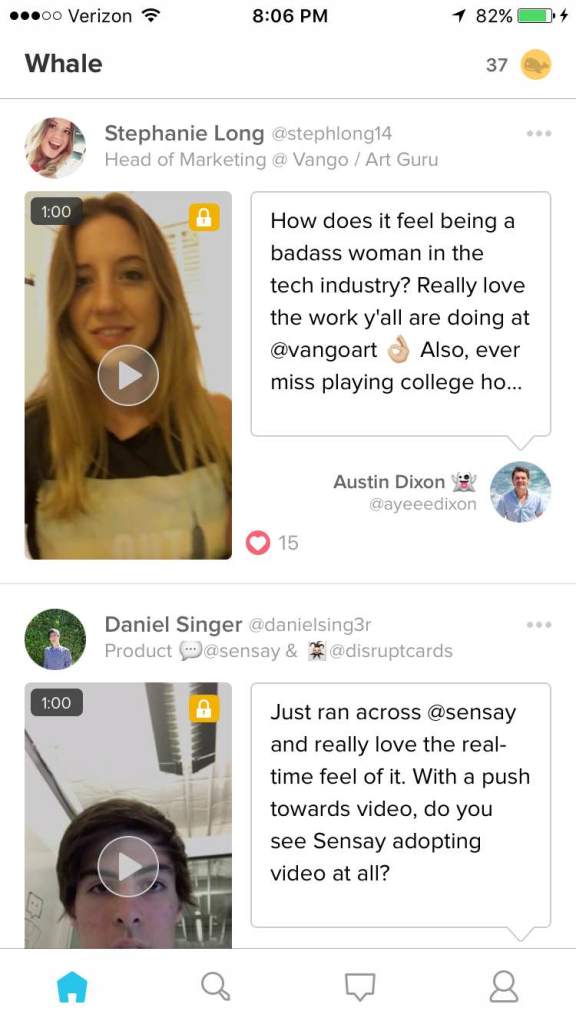
I view Whale as mostly doing two things: (1) reducing search costs and (2) increasing access.
Reducing Search Costs
Many of the questions on Whale have already been answered in other forms. How many times have I heard Justin Kan recommend a trial period before startups hire key employees (especially potential co-founders)? (A lot). Likewise much of what Nir Eyal answers can be found on his blog.
However, even if a particular influencer has answered your question in a particular forum, finding that answer can be expensive. You may have to watch hours of interviews, read numerous articles, or begin following them on Snahpchat and try to reach out.
Whale reduces search costs since you can reach out directly to influencers and get an answer. The tradeoff for shorter search costs is higher monetary costs (you have to pay to ask questions).
Increasing Access
There are two aspects of increased access. The first is elevated status. Some users may view it as a measure of status to be able to have direct access to key influencers.
The other aspect of access is being able to ask a specific question to a particular influencer even if a similar question (but not the exact same question) has already been asked or if the same question has been answered by a similar influencer.
Implications
-The monetary cost of asking a question needs to be lower than the search cost of looking for a pre-existing answer.
-To truly act as a platform that reduces search costs discoverability needs to be improved. Qoura does a good job in this arena (when you type in your question a list of possible duplicate questions appears with good accuracy). This may include surfacing not only questions that have been asked, but the content of the answers.
-Whale should find ways to better let users find new influencers (if you liked a large portion of questions by Influencer X you may also like Influencer Y).
-Whale should find more ways to increase the status of question askers and improve interaction between influencers and question askers.
-Access is more valuable the more influencers that are on Whale.
-Access is more valuable if answers are longer.
-Answer quality needs to remain high. Some users are good at rifing and answering quite well off the cuff. Others go a minute and seem to say virtually nothing. Whale should go the AirBnB route and ensure the quality of answers early on remains high (and give instruction/tutoring/suggestions to ensure answer quality remains high).
I know from following the company closely that many of these improvements are in the work.
Things I worry About
-The platform becoming a forum for users to ask favors instead of questions (“Can you review our proposal?” or “Can you fund us?”) or ask aggressive questions (“Why did you donate X million dollars to racist/communist candidate Y”) which will drive away influencers.
-Growth stalls which leads to quick abandonment.
-The mixed incentives between influencers weeding out duplicate questions and influencers answering duplicate questions to get paid leads to duplicate questions which reduces discoverability even given good search.
-Influencers getting asked so many questions they can’t answer all of them. This will either mean askers pay, but don’t get their question answered (reducing access) or the price of a question gets driven to, say $20-$50 a question, so that the average user is dissuaded from asking a question especially given the risk of low quality (the response could be a one-minute answer that isn’t helpful).
-Navigation/search/discoverability won’t improve (I view this as a really hard — probably impossible in many respects — problem that no one has really come close to solving).
-People in fact like longer form answers.
-People in fact like medium length, meandering conversations rather than specific short-form content.
-Asking influencers questions isn’t as interesting as we think or it is only interesting to a small group or it is only interesting for a short time before the fun wears off.
-Even given search costs there are so many existing resources online that Whale won’t catch on.
-Influencers are too busy to join Whale or sustain a high level of involvement (think about how many influencers started Snapchats and have since quit). This will lead to less influential, “regular people” most available to answer questions, but users will not be willing to pay this type of “influencer” to answer questions.
-Whale will fail to catch on for complex, not fully understood reasons.
-Whale will remain a niche for the tech community rather than expand to other types of content (which I actually view as fine).
Links
The U.S. is not the only country experiencing presidential protests.
“What’s your best approximation of Benedict Cumberbatch’s name in such a way that doesn’t make sense but everyone still knows who you’re talking about?” (My favorite is Bumpercar Candysnatch)
Robert Morris will offer video game scholarships to ‘e-athletes’
“The best 100 films of the 21st century, according to 177 film critics around the world”
The reason Photoshop was invented
Or is this the reason Photoshop was invented? (Dad turns his 6-year-old son’s drawings into reality)

This tilting house forces roommates to cooperate
Voting Thought Experiments
How many more people vote because they get to show off their status with “I voted” stickers? Because they get free stuff? When will someone use county level voting data with exogenous variation in distance from “I voted” sticker manufacturing to figure this out? (Half joking).
How many fewer people would vote if it were forbidden to post a selfie with an “I voted” sticker?
How many fewer people would vote if it were forbidden to post anything at all about it on social media? What about if we were forbidden from discussing whether we voted or not and from asking others if they voted? What if additionally all voting was online and no one would ever see you stand in line at a voting location or drop off a ballot?
It’s all related to signaling of course. In fact, there is already some research on these issues.
Researchers Detect Emotions Using Wireless Signal
I was tipped off to this by Nir Eyal via Justin Kan’s new Q&A app Whale. Very cool technology.
Good Interview with Reid Hoffman
The first 5 minutes of this interview make me think Reid Hoffman is fresh off reading his copy of Sapiens by Yuval Harari, which was popular with the Silicon Valley Crowd. Lots to learn from this interview.
 James McCammon