Links

The U.S. is not the only country experiencing presidential protests.

What’s your best approximation of Benedict Cumberbatch’s name in such a way that doesn’t make sense but everyone still knows who you’re talking about?” (My favorite is Bumpercar Candysnatch)

Robert Morris will offer video game scholarships to ‘e-athletes’

The best 100 films of the 21st century, according to 177 film critics around the world

World’s greatest escape

The reason Photoshop was inventedkirby-jenner-kendall-photoshop-instagram-lYb.png

Or is this the reason Photoshop was invented? (Dad turns his 6-year-old son’s drawings into reality)

8NdyDpk.jpg

Incredible StarWars fan film

This tilting house forces roommates to cooperate

Why I Voted Against Seattle’s ST3 Light Rail Expansion

It is looking more likely that the Seattle area’s $54 billion ST3 light-rail extension will be approved. I voted against it. Here is why.

Being cool isn’t the same thing as being effective

Underlying many of the pro-light-rail arguments that abound — at least those by the casual voter I see on Facebook and overhear around the city — is an air of coolness and futurism. This isn’t articulated explicitly, but here’s a thought experiment to get my point across: suppose we had a ballot proposal to spend $54 billion on a bus expansion package (bus only express lanes, new long-range hybrid buses, more city-to-city bus routes, etc.). What would the reaction be? Probably something like, “Are you kidding me, $54 billion for a bunch of buses?!?! We could build light-rail for that much!” We could (or maybe not as I’ll discuss), but the question is why is light-rail inherently better than other alternatives?

What I hear most are rants about how China and Japan have high-speed rail, how Europe survives on it, how great it was to visit San Francisco and be able to take the BART. Obviously all of this is awesome so of course we should have more rail lines.

Yes, it is indeed great to rail around San Francisco on a train system that you did not pay to construct and do not pay to maintain in a city in which your main purpose is sightseeing not living and commuting to work. But the year is now 2016 and the question is whether we should spend $54 billion and 25 years building a light-rail system or think harder about the alternatives.

It doesn’t pass the sniff test

The one argument you do hear regarding the ST3 expansion is Seattle’s increasingly horrendous traffic. The scrawling of Seattle locals on Facebook every time a new “Top 10 Worst Cities for Traffic” is a smug reminder that if light-rail would’ve actually gotten funded 30 years ago “when it should have” that we wouldn’t have this traffic problem: “Gee, do you think we need light-rail?” the fake rhetoric proceeds.

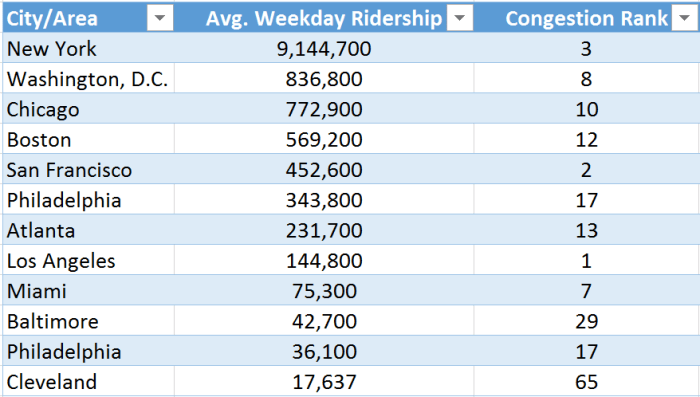
But this argument doesn’t pass the sniff test. Rail ridership does not largely correlate with reduced congestion. I put together a simple dataset to show this (table below). Many of the cities with the largest weekly U.S. rail ridership also have the worst congestion.

Does this simple table prove we shouldn’t expand light-rail? No. It’s only a sniff test. But that’s precisely the point. The story is more complicated so we should think harder when drawing a direct line from Seattle’s congestion problems to its lack of expansive rail.

(By the way, researchers have found similarly negligent effects on congestion from light-rail and here is more research on the issue).
Capture.PNG

The project violates a basic economic principle

The principle being that projects should be paid for by the people that use them. Although this principle is mostly adhered to in the current budget, there is still $4.67 billion in federal grant funding meaning tens of millions of Americans that never ride Seattle’s light-rail will end up paying for it. Sure, we end up paying for a bunch of projects we’ll never use in cities we’ll never visit, but that doesn’t mean we should impose the same cost on others.

The principle is violated at the local level too since every tax payer will help front the bill for light-rail regardless of whether they end up riding it (a very small portion of operating costs come from fare revenue).

It costs ALOT (and will probably cost more)

It costs $54 billion!!! That’s a lot of money!!! And $28 billion of that is increased taxes. And that’s a lot of money!!! Sure cost alone does not indicate the merit of a project, but it does mean we should think really, really hard before moving forward. And it puts the onus on the proposers to make a very strong case about why the project is going to be awesome. In my view they haven’t done that.

And if history is any indication it could actually cost (much) more. This was written about the original lightrail project back in June of 2013:

Sound Transit’s light-rail system, called Link, has also had its share of challenges. The 25 miles of light rail that voters were told would be completed by 2006 at a cost of $1.7 billion, have resulted in 23 miles of track which, when completed, will end up costing $5.2 billion.

In other words the project cost 3 times more than originally projected for two fewer miles.

Overruns of these magnitudes are the rule not the exception. Here, Bent Flybbjerg has done great work (I recommend this interview). His research on megaprojects is gloomy (a megaproject is one that costs more than $1 billion and affects more than 1 million people). In a 2014 paper he wrote the following (emphasis mine):

Performance data for megaprojects speak their own language. Nine out of ten such projects have cost overruns. Overruns of up to 50 percent in real terms are common, over 50 percent not uncommon. Cost overrun for the Channel tunnel, the longest underwater rail tunnel in Europe, connecting the UK and France, was 80 percent in real terms. For Denver International Airport, 200 percent. Boston’s Big Dig, 220 percent. The UK National Health Service IT system, 400-700 percent. The Sydney Opera House, 1,400 percent (see more examples in Table 2). Overrun is a problem in private as well as public sector projects, and things are not improving; overruns have stayed high and constant for the 70-year period for which comparable data exist. Geography also does not seem to matter; all countries and continents for which data are available suffer from overrun. Similarly, benefit shortfalls of up to 50 percent are also common, and above 50 percent not uncommon, again with no signs of improvements over time and geography (Flyvbjerg et al., 2002, 2005).

ST3 will serve mostly current transit riders

The Washington Policy Center used Seattle Sound Transit figures to estimate that only 28 thousand new daily riders would be added by 2040. What they found is, well, troubling (emphasis mine):

This means that under ST3, each new transit rider will cost over $1 million dollars.

It also means that 97% of the one million new residents expected in 2040 will likely not be using Sound Transit’s costly services, meaning Sound Transit officials do not meet the demand for mobility they themselves anticipate.

If Sound Transit officials want to keep hypothesizing what they can do in theory – using the median price of a single-family home in King County, they could buy every new passenger a home and still have plenty left over ($38.2 billion) for:

– 8,000 new hybrid articulated buses
– Paying back taxpayers for the SR 520 bridge replacement
– Eliminating tolls and providing tax relief on the Viaduct replacement project
– Expanding I-90 through Snoqualmie Pass

Yet even after all this spending, they would still have enough left to buy those same homes for the 4,505 homeless people in Seattle, ending homelessness in the city with $21.8 billion still left in their bank accounts.

And here’s the abstract of a 2015 study making a similar point (emphasis mine):

We examine American support for transit spending, and particularly support for financing transit with local transportation sales taxes. We first show that support for transportation sales tax elections may be a poor proxy for transit support; many voters who support such taxes do not support increased transit spending, and many people who support transit spending do not support increased sales taxes to finance it. We then show that support for transit spending is correlated more with belief in its collective rather than private benefits—transit supporters are more likely to report broad concerns about traffic congestion and air pollution than to report wanting to use transit themselves. These findings suggest a collective action problem, since without riders transit cannot deliver collective benefits. But most transit spending supporters do not use transit, and demographics suggest they are unlikely to begin doing so; transit voters are wealthier and have more options than transit riders.

There are better alternatives

As Edward Glaeser recently said in an interview with Vox.com:

There’s a strong consensus that maintaining existing infrastructure gives you much more bang for your buck. There have been diminishing returns to building new roads, particularly since we completed the National Highway System. Whereas if you have existing corridors with potholes, the returns to fixing that are very high. [See here for more.]

Another area of agreement among transportation economists is a profound enthusiasm for buses over trains. Bus rapid transit is considered a very high-return investment. These aren’t necessarily buses operating on crowded city streets; these are buses with dedicated lanes that can achieve almost the same speed as trains.

The beauty of buses, from a cost-benefit perspective, is you don’t need to lay down massive infrastructure that you’re stuck with forever. If a bus route doesn’t attract enough people, you switch the route. Or you stop running it. It’s flexible in a way that trains aren’t. And that’s tremendously valuable in a world of uncertainty.

Now, this is not about gutting the subway in New York or the Metro in Washington, DC. But for new stuff, investing in buses tends to make more sense given the modest densities of most American metropolitan areas.

No, I don’t hate light-rail

In fact I live in Seattle and take it to work daily. And I love trains in general. I once traveled from Hong Kong to Madrid completely by train (just thought I’d find a way to throw that in there). But I see critical problems with the current proposal and I have mixed feelings about Seattle’s current light-rail.

For one, Seattle’s light-rail is rarely full except during a morning rush hour and again during an evening one. And even during these peak times the capacity is fractions of that seen on Asian rail lines (I’ve lived in Seoul) and even many in Europe. Sure, some people may see that as a feature and not a bug, but when current capacity is easily met and we’re already talking about spending $54 billion on a new system I think it’s time to stop and think. Yes, the city is growing and will likely continue to grow, the question is what is the benefit of light-rail in that climate and are there better and cheaper alternatives.

This is not to mention my commute is actually 25 minutes longer under the current light-rail regime because the 71, 72, and 73 buses were all rerouted from an express lane route that led directly downtown. Now they go — guess where — to the nearest light-rail station.

Third, the four crucial light-rail stops downtown use the same tunnel as bus traffic and so are subject to the same delays. If a bus breaks down or is slow letting passengers off, the light-rail must wait for the bus to move on. If you are not from Seattle you might have though that the original $5 billion construction project would’ve gotten light-rail a dedicated track, but you’d only be correct outside of the downtown area. These are not theoretical delays; these are daily delays. This is not life’s biggest tragedy, but we all know the feeling of wanting to get home after a long day and when you’re on a motionless train stuck behind a bus (!) and are delayed for two minutes at each of four out of your total six stops you do start to question if the money was worth it.


Voting Thought Experiments

How many more people vote because they get to show off their status with “I voted” stickers? Because they get free stuff? When will someone use county level voting data with exogenous variation in distance from “I voted” sticker manufacturing to figure this out? (Half joking).

How many fewer people would vote if it were forbidden to post a selfie with an “I voted” sticker?

How many fewer people would vote if it were forbidden to post anything at all about it on social media? What about if we were forbidden from discussing whether we voted or not and from asking others if they voted? What if additionally all voting was online and no one would ever see you stand in line at a voting location or drop off a ballot?

It’s all related to signaling of course. In fact, there is already some research on these issues.


This Discovery is On Fleek

I just learned — to my delight — that the term “On Fleek” was created by a Colorado woman named Peaches Monroee (great name) in a Vine video.

I think it’s really great the effect the internet has had on the etymology of modern words. Often when you read about etymology things get fuzzy as you go further back in time and often it’s really hard to be certain when a word was created or when it’s meaning changed. For example, take the famous linguistic row over the word decimate.

It’s really interesting to be able to identify the moment “on fleek” was created and as technology continues to advance one day we’ll probably be able to literally plot out the spread of words.

Twitter has announced that it is closing down Vine.

Interesting Links I’ve Come Across Lately

1. This Kenyan Olympic Javelin Thrower Taught Himself with Youtube Videos, Now He’s a Champion

Video included.

2. BBC Try Before You Buy

The BBC’s new Taster platform let’s you explore beta versions of TV shows.

Is there an audience out there for classic natural history programming à la David Attenborough, but dubbed over with more absurd commentary from the comedy band Flight of the Conchords (“New Zealand’s 4th most popular guitar-based digi-bongo a-capella-rap-funk-comedy folk duo”)?

3. Why an Exotic Dancer is Financially Just Like Your Hairdresser

“…That was the night I tipped out $700.”

4. One Car Can Prevent a Traffic Jam

Driver-education schools try to train students to stop tailgating, leave wide gaps between cars and take turns when merging, but “people have to unlearn what they’ve been taught” about standing in line, says Dave Muma, president of the Driving School Association of the Americas, a trade group. “Kids are trained at a very young age that they have to get in line and not let people cut in front of you”—rules that work well on the playground but cause gridlock on the highway, says Mr. Muma, owner of a Holland, Mich., driver-education company.

5. How to Visit Every US Zip Code in the Most Efficient Roadtrip Ever

6. FilmMeets Art II from Vugar Efendi on Vimeo.

7. Two Links on Death

…That is all that remains in the final weeks, love and relationships.

What happens when you make an AI version of your dead best friend?

Someday you will die, leaving behind a lifetime of text messages, posts, and other digital ephemera…new services will arrive offering to transform them — possibly into something resembling [a virtual version of yourself that can speak from beyond the grave]. Your loved ones may find that these services ease their pain. But it is possible that digital avatars will lengthen the grieving process. “If used wrong, it enables people to hide from their grief…”

8. The Only Plane in the Sky

Reflections on the immediate aftermath of 9-11 from those aboard Air Force One”

Rep. Adam Putnam: There was one van, maybe a press van, that was parked too close to the plane’s wing. I remember a Secret Service agent running down the aisle; they opened the back stairs, he ran down to move the truck. He never made it back on board. They didn’t wait for him.

9. How to fake your own death

Hint: get lost hiking.

10. A delightfully odd and informative Paul Holdengräber interview with Malcolm Gladwell at the New York Library

Paul Holdengräber, upon hearing an ongoing chirping noise: “There’s that sound again. I’m not sure if I like it or don’t like it, but it’s very present.”

11. A Short History of Barbed Wire

Barbed wire was surprisingly crucial to the development of modern life, both for better and worse.

12. What Was it Like to Buy and Own a Car in the USSR

Remember that famous Ronald Reagan joke about buying a car in the Soviet Union? If you haven’t, it goes like this: a guy in a Soviet country is told he has a 10 year wait for a car.

This man laid down the money, and the fellow in charge said to him: Come back in 10 years and get your car.

The man answered: Morning or afternoon?

And the fellow behind the counter said: Ten years from now, what difference does it make?

And he said: Well, the plumber is coming in the morning.

It’s funny because it’s basically true.

13. Employee Number 1 at Apple

When I was in seventh and eighth grade I went to Cupertino Junior High School, which was just behind my backyard fence. I think maybe halfway through seventh grade Steve Jobs came to the school. He and I were both deeply introspective, very philosophical. Neither of us wanted to play the social games that you needed to play to be accepted into any of the numerous cliques that define the social scene for 13 and 14 year olds in junior high school. So we eventually gravitated towards each other and started hanging out. We became fast friends. I got him interested in electronics…

14. P-Values are Back in the News

One of the better explanations of the problem. See my previous post on p-values here.

15. Quantum Stuff

Quirks and Quarks Description of Quantum Teleportation, only nine minutes, but one of the clearer explanations I’ve heard.

Quantum computing (aka quantum hanky-panky)

16. On the Rise of Trump

This short Cracked article channels much of the more thoughtful research on the rise of Trump (these sources are more empathetic to supporters than thoughtless dismissiveness one commonly hears). For example, see Ezra Klein’s interview with Arlie Hochschild, commentary from Mark Bauerlein on the appeal of Trump as an asshole, George Patton’s speach to the Third Army before the invasion of northern France during WWII (isn’t Trump somehow, if perhaps pervertedly, channeling this sentiment and doesn’t it still strike a chord with many Americans?), Brian Caplan on how bad economic policies — many of which you probably believe — don’t prevent one from voting for politicians that support those policies, Tyler Cowen’s thoughts here, here, and here and also Tyler’s interview with Ezra Klein in which they discuss the lack of good language for non-racist expressions of cultural anxiety, this book review of Democracy for Realists by Christopher Achen and Larry Bartels, or Chris Arnade writings/rants/links on Twitter.

17. Ken Bone is Even More of An Everyman than We Realized

18. Susan Athey is My New Favorite Economist

Here is her talk on bitcoin (the best I’ve heard).

Here is her keynote at a conference on “Artificial Intelligence: The Economic and Policy Implications” hosted by the Technology Policy Institute.

Here is Susan’s interview on EconTalk, which can be enjoyed fruitfully with this interview from Cathy O’Neil on her new book Weapons of Math Destruction (get it?)

19. Entrepreneurs and Startups

I recommend The Twenty Minute VC podcast. The host is only 20 himself, and somewhat of a wunderkind in the VC community.

I’m excited for Season 4 of StartUp, it sounds like it will be quite good. The twopart story of Coss Marte was my favorite from Season 3.

Kara Swisher is always strong on Recode Decode. Currently listening to her interview with Aileen Lee, the woman that invented the term “Unicorn” (which refers to a startup that obtains a billion dollar valuation within 10 years of its founding).

YC Office hours are always fun to watch. And now a comprehensive startup course from YC is free online!

The New Yorker has a long-form profile on Sam Altman, that is quite good.

In a class that Altman taught at Stanford in 2014, he remarked that the formula for estimating a startup’s chance of success is “something like Idea times Product times Execution times Team times Luck, where Luck is a random number between zero and ten thousand.

In this interview from Sam Altman Elon Musk reveals he gets nervous when he makes business decisions just like everybody else.

On Wooden Skyscrapers

This Economist article talks about the many benefits of modern wooden skyscrapers.

Noise:

…the construction site would be a lot quieter without the heavy plant required to pound deep foundations, pump concrete and install steel supports.

Cost:

…for every lorry delivering timber for a wooden building, five lorries would be needed to deliver concrete and steel. All these things may mean that once the total construction costs are calculated, a wooden building can work out cheaper.

Carbon emissions:

Using wood could reduce their carbon footprint by 60-75%, according to some studies.

The biggest concerns are strength, fire, and rot, but with current technology these are overcome:

Strength:

A wooden building is about a quarter of the weight of an equivalent reinforced-concrete structure, which means foundations can be smaller…In much the same way that aligning carbon-fibre composites creates stronger racing cars, aircraft and golf clubs, CLT [Cross-Laminated Timber] imparts greater rigidity and strength to wooden structures.

Fire resistance:

In general, a large mass of wood, such as a CLT floor, is difficult to burn without a sustained heat source—for the same reason that it is hard to light a camp fire when all you have is logs…with other fire-resistant layers and modern sprinkler systems, tall wooden buildings can exceed existing fire standards.

There is also a method that combines small concrete layers on top of a wooden foundation between floors to help reduce floor-to-floor noise and further improve fire resistance.

Rot:

What about woodworm and rot? “If you don’t look after it, steel and concrete will fail just as quickly as timber,” says Michael Ramage, head of the Centre for Natural Material Innovation at the University of Cambridge in Britain.

Ryan Avent Interview

This Derek Thompson interview with Ryan Avent is interesting throughout. Here is one bit:

It is ironic that liberals, who in the abstract support more inclusive immigration and shared wealth, often live in coastal metros areas that are exclusive by design—they are built around water, limit housing height, and declare certain zones out-of-bounds for further construction. As you point out in the book, one of the tallest buildings in New York City is a residential tower on Park Avenue that is home to a stack of billionaires who, although they could live in any ZIP code on the planet, have chosen to live on top of each other, like candies in a Pez dispenser.

And this (on life after automation):

The very rich will still want people, their own personal shoppers and assistants. Being able to retain human labor would be a sign that you’re wealthy. So even in a future city that had a lot of laborers replaced with technology, you might still have artisanal service sector workers.