A Couple of Interesting Things I Recently Learned

Trees

Last week Uttar Pradesh planted 49 million trees…in a single day. Remarkably 800,000 citizens participated, which might be the most surprising aspect of the story. I’ve never heard of 800,000 citizens coming together for a single volunteer event on a single day. Jonah Busch calculates that roughly 100,000 tons of carbon will be offset as a result. Source here.

Ferrets

I’m reading The Master Algorithm and just read that in the year 2000 researchers rewired the brains of ferrets so the ears connected to the visual cortex and the eyes connected to the auditory cortex. But over time those parts of the brain learned to understand the new signals: the visual cortex learned to hear and the auditory cortex learned to see. I thought that was pretty amazing! Also curious how in the world you rewire a brain.

Human Echolocation

Also via the The Master Algorithm comes the story of Ben Underwood who uses human echolocation to “see” (yes, just like bats). This is almost too strange to imagine, but I’ve linked to the video below. Note that Ben has completely lost his eyes to cancer so there is no way he can be “faking.”

Noma’s Michelin Rating

I’m an extremely inchoate foodie that loves Top Chef. Currently making my way through Chef’s Table and doing some side research. Surprisingly, I learned that the restaurant Noma, run by chef Rene Redzepi and routinely ranked as the best restaurant in the world,  only has two Michelin stars (out of a possible three). The discrepancy comes from the fact that “The World’s 50 Best Restaurants” list is put together by Restaurant Magazine, while Michelin gives out the star ratings. Apparently, this is a well-known dispute in the high-end food world. The discrepancy is quantifiable. Noma is currently the 5th best restaurant on the 50 Best list (down after a number of years ranked as Number 1). However, receiving only two Michelin stars means Michelin believes there are 119 better restaurants in the world.

By the way, Noma serves live ants on its menu.

750,000 VCRs Were Sold Worldwide Last Year

That is from this CNN article.

I don’t know what to think about this number. In some ways it seems impossible that any were sold. I can’t remember the last time I watched a VHS film.

On the other hand there must still be millions or even tens of millions of old VHS tapes around (my parents have a small bookshelf full) and of course you need something to watch them on. Given the frequency at which VCRs break maybe I would have guessed that even more units were sold. This is another technology I suspect many in low-income countries skipped.

Apparently Funai Electric is the last maker of new VHS machines and will cease production this month. However, a quick search on Amazon shows a few DVD-VHS combo players, so perhaps this is all just a technicality.

New UW Report Finds Seattle’s Minimum Wage Doing Modestly Well For Some Low-Wage Workers

Recently a few friends of mine have linked to this article, which summarizes a new University of Washington study about the Seattle minimum wage increase. The article headline reads, “New UW Report Finds Seattle’s Minimum Wage Is Great for Workers and Businesses.” My friends like to add snarky comments feigning surprise, implying that of course the minimum wage is great for workers and businesses.

SMH.

1. The “of course” intuition runs in the opposite direction.

Demand curves almost always slope downward so our naive intuition would be that business will shed low-wage workers because they cost more under a minimum wage regime. It was only after David Card and Alan Krueger’s 1993 paper (and the subsequent papers that utilized a similar difference-in-difference strategy*) that economists had hard evidence that small minimum wage increases might not reduce employment.

*Difference-in-Difference is an easily understood technique in which you compare the starting and ending points of two different rates to see how they performed relative to one anther. My mile time was 11 minutes last year, but now it’s 10 minutes. Your mile time was 11:30, but now it’s 9 minutes. I improved by one minute, but you improved by two minutes and thirty seconds. One minute and thirty seconds is the difference between our individually differenced before and after times, which is where the technique gets its name (difference is just another word for subtraction).

Suppose we’re genetically similar, say, for example, that we’re twins. We now know that the difference in our mile time improvements over the past year was due to our different training regimens and not genetics and — setting aide the fact that we only have a sample size of two — we now have proof that your workout regimen is better (at least for people that share similar genes).

The attractive thing about difference-in-difference experiments is that they don’t use any fancy math: the results are both easy to calculate and easy to understand. If you can find two people — or groups, or cities, or things — that are similar and can track their performance over time all you have to do at the end is subtract a couple of times and you have a statistically valid result.

2. The headline and content of the article sorely misrepresents the results of the study.

The article’s author cites only the Seattle increase portion of the difference-in-difference approach. It’s the equivalent of me citing my increased mile time and telling you how great my workout plan is without telling you that my twin did much better with a totally different workout plan. Most of the increase in employment and business success was due to the recent strength of the Seattle economy. An acquaintance that recently started at Amazon told me they just had their largest orientation ever, 600 new employees.

Ultimately the authors conclude with this finding:

The major conclusion one should draw from this analysis is that the Seattle Minimum Wage Ordinance worked as intended by raising the hourly wage rate of low-wage workers, yet the unintended, negative side effects on hours and employment muted the impact on labor earnings.

The authors don’t find that the minimum wage increase was “great” for businesses, but instead mostly a wash. There was a small, 0.7 percentage point, increase in the rate of business closure. The authors also note that:

A higher minimum wage changes the type of business that can succeed profitably in Seattle, and we should thus expect some extra churning. Our results are consistent with those of Aaronson, French, and Sorkin (2016), who conclude that minimum wage laws prompt increases in both entries and exits (particularly in chains), with closures coming from more labor intensive industries and establishments, and more openings occurring in more capital intensive industries.

I think this structural realignment is foreboding for the future of Seattle’s low-wage workers. The minimum wage currently stands at “only” $11 and we’re a year into the experiment. What happens in seven years and an additional $7 in hourly pay? There could be serious negative structural adjustments to low-wage industries.

So what about the workers themselves? The best estimate is that the minimum wage decreased low-wage employment by 1 percentage point. Far from “great.” The workers that were still employed did experience modest gains in material well-being:

Seattle’s low-wage workers who kept working were modestly better off as a result of the Minimum Wage Ordinance, having $13 more per week in earnings and working 15 minutes less per week.

One has to ask themselves if the minimum wage was so great why didn’t low-wage workers flood into the Seattle area? On the contrary the authors find the following:

…we conclude that the Seattle Minimum Wage Ordinance reduced the probability of low-wage workers continuing to work in the Seattle (rather than elsewhere in the state) by 2.8 percentage points.

So bad was the misrepresentation of this article, which my friends footnote with duh-obviously-the-minimum-wage-is-great style comments, that Jake Vigdor, the lead author of the study, himself responded in the comments section:

As director of the Seattle Minimum Wage Study, it is my sad duty to report that this article grossly mischaracterizes the tenor of our report. I encourage readers to refer directly to that report:https://seattle.legistar.com/View.ashx?M=F&ID=4579065&GUID=39743A75-1D9F-4C32-B793-2F699D51B0F7


3. An argument against the minimum wage is not an argument to condemn the poor.

The minimum wage is only one poverty reduction strategy. Many economists are in favor of small increases in the minimum wage because there is a lot of evidence that suggests the impact on employment is small or non-existent (or even slightly positive). But many economists are quite nervous or ambivalent about $15 minimum wage increases. As this Forbes headline notes, “Even Alan Krueger Thinks That A $15 An Hour Minimum Wage Is Too High.” And Alan Krueger helped pioneer the argument in favor of the minimum wage!

See this poll and this poll for reference.


4. Shouldn’t we read things before we comment about them?

This echos my thoughts in an early post about things I do and don’t hear in Seattle.

A Reddit Thread Linked to My Blog…

…and I got over 1,000+ visitors in 8 hours during the late evening of July 17th. The Reddit thread is here. Strangely enough the link was to my post on the political pornography of Marie Antoinette on the “Today I learned” subreddit. I wrote the paper during a UW class on the French Revolution. The thread was about a user that learned Antoinette never said “Let them eat cake.” There are very few places on the internet regarding the political pornography of Marie Antoinette (not surprisingly) and luckily(?) for me my post is one of them.

Lean In Review

16071764.jpg

A good bordering on great book, underrated as a result of overly contentious discussions about Sandberg’s privilege. This is true even given her recent comments after her husband’s death. I wonder how many critics actually read the book. The book is clearly meant for a particular audience, but isn’t everything?

Take this section from the introduction, for example.

Some, especially other women in business, have cautioned me about speaking out publicly on these issues. When I have spoken out anyway, several of my comments have upset people of both genders. I know some believe that by focusing on what women can change themselves — pressing them to lean in — it seems like I am letting our institutions off the hook. Or even worse, they accuse me of blaming the victim. Far from blaming the victim, I believe that female leaders are key to the solution. Some critics will also point out that it is much easier for me to lean in, since my financial resources allow me to afford any help I need. My intention is to offer advice that would have been useful to me long before I had heard of Google or Facebook and that will resonate with women in a broad range of circumstances…

I am also acutely aware that the vast majority of women are struggling to make ends meet and take care of their families. Parts of this book will be most relevant to women fortunate enough to have choices about how much and when and where to work; other parts apply to situations that women face in every workplace, within every community, and in every home. If we can succeed in adding more female voices at the highest levels, we will expand opportunities and extend fairer treatment to all.

Overall there was a lot of clear thinking for both men and women in the workplace and interesting data. I especially like the detailed sections on the challenges of childbirth and childcare, on being more assertive in the workplace, and on learning not to be too hard on one’s self.

Durant to the Warriors

In breaking news (that I myself did not break) Kevin Durant has signed with the Golden State Warriors.

Thoughts

1. Haters gonna hate.
The haters have already come out en mass calling Durant a traitor, saying that his exit is worse than The Decision (LeBron James’s announcement that he was leaving Cleveland to go to the Miami Heat). I always find this point of view strange. Try applying the logic to anything else in life and it sounds absurd: You graduate college. You don’t get to choose where you get a job, instead you are “drafted” by Microsoft. You try diligently for nine years to overtake Apple. You fail. Your teammates are great, but an even better team awaits at Facebook that has an even better chance of overtaking Apple as the world’s top technology company. You decide to leave. Who will call you a traitor?

On the other hand there is this:

13606469_10105278370854398_2005399536903163743_n.jpg

2. Sports matter.
The thought experiment above is just a reframing of the idea that sports really matter to people. Their brains turn off, tribal affiliation and emotions kick in. I always find it silly when non-sports fans deride enthusiasm toward sport and suggest we devote that energy to “something that matters.” Sports matter. As much as anything in our society sports matter. To millions (billions?) of people around the world a fan’s home team is a part of their identity and rooting for another team is as unimaginable as adopting another family. In a very real sense their home team and their home team’s fans are a part of their family.

Screen Shot 2016-07-04 at 11.02.09 AM.png Screen Shot 2016-07-04 at 11.00.59 AM.png

3. The best ever.
The Warriors’ starting lineup is now considered the best ever. Last year — without Durant — they won 73 games, the most in NBA history! More than teams that included Michael Jordan, Magic Johnson, LeBron James. Durant is the second best player of his generation behind LeBron and one of the best players of all time. Steph Curry is the best player of his generation. The Warriors already had arguably the two best 3-point shooters of all time in Curry and Thompson. Now they have three of the top — what? Maybe 10 or 20 — shooters of all time! Draymond Green is one of the best all around players in the league, perhaps of all time by the time he retires (he finished second in NBA Defensive Player of the Year Award voting in 2016 and second in triple doubles). Three of the Warriors’ new starting five received regular season MVP votes last year. Between Durant and Curry they’ve won the past three regular season MVPs. Iguodala came in second for the NBA’s Sixth Man Award this year (and won the Finals MVP a year ago). Has any team like that ever been assembled?  The Warriors’ 12-man lineup includes many solid roll players so even if you replace Iguodala with Bogut or Livingston you still create the greatest lineup ever (Update: Bogut will likely be traded to clear up cap space for Durant).

Screen Shot 2016-07-04 at 10.50.01 AM.png

4. But remember…
The Championship was handed to the Miami Heat after LeBron, Wade, and Bosh joined forces in 2010. That team went 2-2 in the Finals. An accomplishment to be sure, but it’s not like we could just pencil them in as champions every year. Remember when Howard and Nash joined the Lakers? They became a favorite to get to the finals; they didn’t even make the playoffs. Let’s not speak too soon about the success of these new Warriors.

Screen Shot 2016-07-04 at 10.45.27 AM.png

5. Russell Westbrook must be PISSED.
Steph Curry is one of Westbrook’s most hated foes and now Durant — the man that once called Westbrook a brother — has left to play with that foe. Ouch!

Screen Shot 2016-07-04 at 10.41.59 AM.png

Testing Tony Kornheiser’s Football (Soccer) Population Theory

Fans of the daily ESPN show Pardon the Interruption (PTI) will be familiar with the co-host’s frequent “Population Theory.” The theory has a few formulations; it is sometimes asserted that when two countries compete in international football the country with the larger population will win, while at other times it’s stated that the more populous country should win.

The “Population Theory” sometimes also incorporates the resources of the country. So, for example, Kornheiser recently stated that the United States should be performing better in international football both because the country has a large population, but also because it has spent a large sum of money on its football infrastructure.

I decided to test this theory by creating a dataset that combines football scores from SoccerLotto.com with population and per capita GDP data from various sources. Because of the SoccerLott.com formatting the page wasn’t easily scraped by R or copied and pasted into Excel, so a fair amount of manual work was involved. Here’s a picture of me doing that manual work to breakup this text 🙂

IMG_4265

The dataset included 537 international football games that took place between 30 June 2015 and 27 June 2016. The most recent game in the dataset was the shocking Iceland upset over England. The population and per capita GDP data used whatever source was available. Because official government statistics are not collected annually the exact year differs. I’ve uploaded the data into a public Dropbox folder here. Feel free to use it. R code is provided below.

Per capita GDP is perhaps the most readily available proxy for national football resources, though admittedly it’s imperfect. Football is immensely popular globally and so many poor countries may spend disproportionately large sums on developing their football programs. A more useful statistic might be average age of first football participation, but as of yet I don’t have access to this type of data.

Results

So how does Kornheiser’s theory hold up to the data? Well, Kornheiser is right…but just barely. Over the past year the more populous country has won 51.6% of the time. So if you have to guess the outcome of an international football match and all you’re given is the population of the two countries involved then you should indeed bet on the more populous country.

Of the 537 games, 81 occurred on a neutral field. More populous countries fared poorly on neutral fields, winning only 43.2% of the time. While at home the more populous country won 53.1% of their matches.

Richer countries fared even worse, losing more than half their games (53.8%). Both at home and at neutral fields they also fared poorly (winning only 45.8% and 48.1% of their matches respectively).

The best predictor of international football matches (at least in the data I had available) was whether the team was playing at home: home teams won 60.1% of the time.

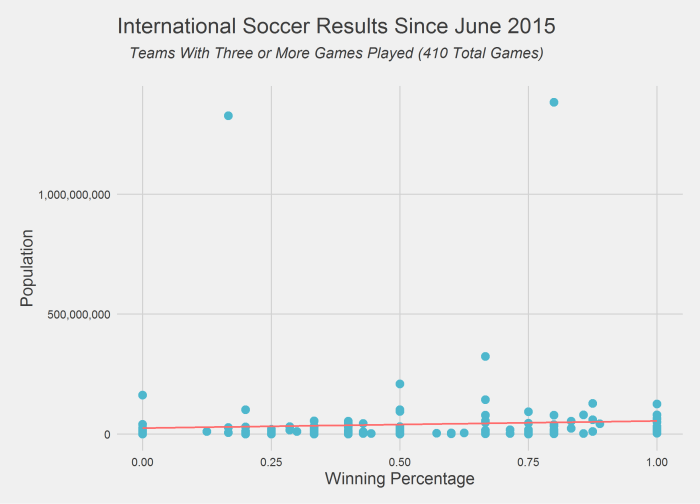
To look more closely at population and winning I plotted teams that had played more than three international matches in the past year against their population. There were 410 total games that met this criteria. I also plotted a linear trend line in red, which as the figures above suggest, slopes upward ever so slightly.

population_vs_winning_perct.png

Although 527 games is a lot, it’s only a single year’s worth of data. It may be possible that this year was an anomaly and I’m working on collecting a larger set of data. As the chart above suggests many countries have a population around 100 million or less and so it would perhaps be surprising if countries with a few million more or fewer people had significantly different outcomes in their matches. But we can test this too…

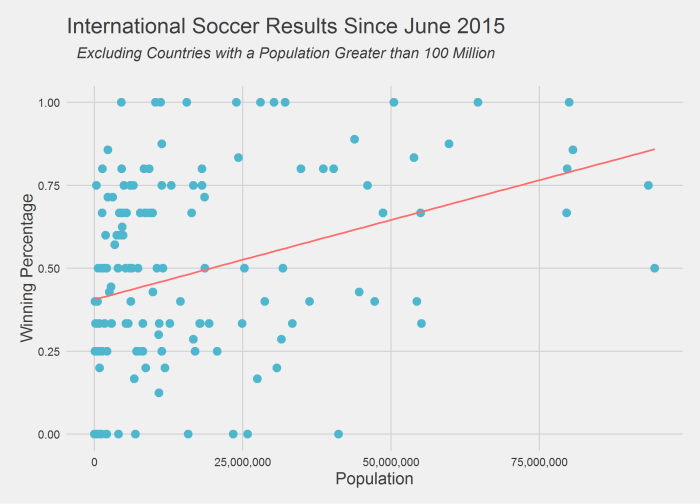
When two countries whose population difference is less than 1 million play against one another the more populous country actually losses 55.9% of the time. When two countries are separated by less than 5 million people the more populous country wins slightly more than random chance with a winning percentage of 52.1%. But large population differences (greater than 50 million inhabitants) does not translate into more victories. They win just 51.2% of the time. So perhaps surprisingly the small sample of data I have suggests that population differences matter more when the differences are smaller (of course this could be spurious).

This can be further seen below in a slightly different view of the chart above that exchanges the axes and limits teams to those countries with less than 100 million people.

population_vs_winning_perct_smaller.png

R code provided below:

###################################################################################################
# James McCammon
# International Football and Population Analysis
# 7/1/2016
# Version 1.0
###################################################################################################
 
# Import Data
setwd("~/Soccer Data")
soccer_data = read.csv('soccer_data.csv', header=TRUE, stringsAsFactors=FALSE)
population_data = read.csv('population.csv', header=TRUE, stringsAsFactors=FALSE)
 
 
################################################################################################
# Calculate summary data
################################################################################################
# Subset home field and neutral field games
nuetral_field = subset(soccer_data, Neutral=='Yes')
home_field = subset(soccer_data, Neutral=='No')
 
# Calculate % that larger country won
(sum(soccer_data[['Bigger.Country.Won']])/nrow(soccer_data)) * 100
# What about at neutral field?
(sum(nuetral_field[['Bigger.Country.Won']])/nrow(nuetral_field)) * 100
# What about at a home field?
(sum(home_field[['Bigger.Country.Won']])/nrow(home_field)) * 100
 
# Calculate % that richer country won
(sum(soccer_data[['Richer.Country.Won']])/nrow(soccer_data)) * 100
# What about at neutral field?
(sum(nuetral_field[['Richer.Country.Won']])/nrow(nuetral_field)) * 100
# What about at a home field?
(sum(home_field[['Richer.Country.Won']])/nrow(home_field)) * 100
 
# Calculate home field advantage
home_field_winner = subset(home_field, !is.na(Winner))
(sum(home_field_winner[['Home.Team']] == home_field_winner[['Winner']])/nrow(home_field_winner)) * 100
 
# Calculate % that larger country won when pop diff is less than 1 million
ulatra_small_pop_diff_mathes = subset(soccer_data, abs(Home.Team.Population - Away.Team.Population) < 1000000)
(sum(ulatra_small_pop_diff_mathes[['Bigger.Country.Won']])/nrow(ulatra_small_pop_diff_mathes)) * 100
#Calculate % that larger country won when pop diff is less than 5 million
small_pop_diff_mathes = subset(soccer_data, abs(Home.Team.Population - Away.Team.Population) < 5000000)
(sum(small_pop_diff_mathes[['Bigger.Country.Won']])/nrow(small_pop_diff_mathes)) * 100
#Calculate % that larger country won when pop diff is larger than 50 million
big_pop_diff_mathes = subset(soccer_data, abs(Home.Team.Population - Away.Team.Population) > 50000000)
(sum(big_pop_diff_mathes[['Bigger.Country.Won']])/nrow(big_pop_diff_mathes)) * 100
 
 
################################################################################################
# Chart winning percentage vs. population
################################################################################################
library(dplyr)
library(reshape2)
 
base_data = 
  soccer_data %>%
  filter(!is.na(Winner)) %>%
  select(Home.Team, Away.Team, Winner) %>%
  melt(id.vars = c('Winner'), value.name='Team')
 
games_played = 
  base_data %>%
  group_by(Team) %>%
  summarize(Games.Played = n())
 
games_won = 
  base_data %>%
  mutate(Result = ifelse(Team == Winner,1,0)) %>%
  group_by(Team) %>%
  summarise(Games.Won = sum(Result))
 
team_results = 
  merge(games_won, games_played, by='Team') %>%
  filter(Games.Played > 2) %>%
  mutate(Win.Perct = Games.Won/Games.Played)
 
team_results = merge(team_results, population_data, by='Team')
 
# Plot all countries
library(ggplot2)
library(ggthemes)
ggplot(team_results, aes(x=Win.Perct, y=Population)) +
  geom_point(size=3, color='#4EB7CD') +
  geom_smooth(method='lm', se=FALSE, color='#FF6B6B', size=.75, alpha=.7) +
  theme_fivethirtyeight() +
  theme(axis.title=element_text(size=14)) +
  scale_y_continuous(labels = scales::comma) +
  xlab('Winning Percentage') +
  ylab('Population') +
  ggtitle(expression(atop('International Soccer Results Since June 2015', 
                     atop(italic('Teams With Three or More Games Played (410 Total Games)'), ""))))
ggsave('population_vs_winning_perct.png')
 
# Plot countries smaller than 100 million
ggplot(subset(team_results,Population<100000000), aes(y=Win.Perct, x=Population)) +
  geom_point(size=3, color='#4EB7CD') +
  geom_smooth(method='lm', se=FALSE, color='#FF6B6B', size=.75, alpha=.7) +
  theme_fivethirtyeight() +
  theme(axis.title=element_text(size=14)) +
  scale_x_continuous(labels = scales::comma) +
  ylab('Winning Percentage') +
  xlab('Population') +
  ggtitle(expression(atop('International Soccer Results Since June 2015', 
                          atop(italic('Excluding Countries with a Population Greater than 100 Million'), ""))))
ggsave('population_vs_winning_perct_smaller.png')

Created by Pretty R at inside-R.org