
Whale is a new app from Twitch (previously JustinTV) creator Justin Kan. The app attempts to connect tech influences with users that can ask direct questions. Influences then record videos that are up to one minute in length answering the question. Questions are locked and users must pay eight coins to unlock each questions. Influences charge a small fee to be asked and question askers get small monetary rewards when other viewers unlock the questions.
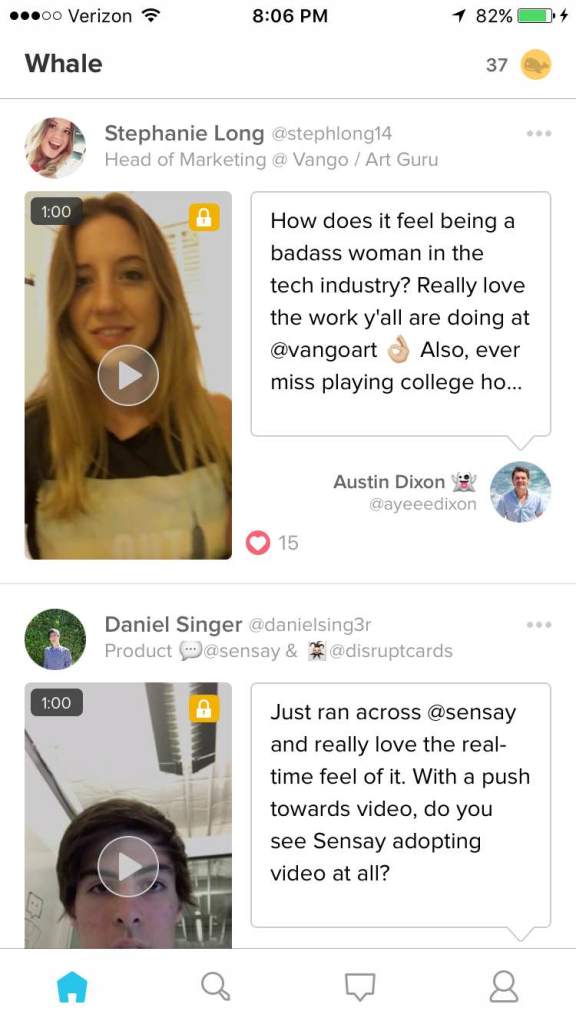
I view Whale as mostly doing two things: (1) reducing search costs and (2) increasing access.
Reducing Search Costs
Many of the questions on Whale have already been answered in other forms. How many times have I heard Justin Kan recommend a trial period before startups hire key employees (especially potential co-founders)? (A lot). Likewise much of what Nir Eyal answers can be found on his blog.
However, even if a particular influencer has answered your question in a particular forum, finding that answer can be expensive. You may have to watch hours of interviews, read numerous articles, or begin following them on Snahpchat and try to reach out.
Whale reduces search costs since you can reach out directly to influencers and get an answer. The tradeoff for shorter search costs is higher monetary costs (you have to pay to ask questions).
Increasing Access
There are two aspects of increased access. The first is elevated status. Some users may view it as a measure of status to be able to have direct access to key influencers.
The other aspect of access is being able to ask a specific question to a particular influencer even if a similar question (but not the exact same question) has already been asked or if the same question has been answered by a similar influencer.
Implications
-The monetary cost of asking a question needs to be lower than the search cost of looking for a pre-existing answer.
-To truly act as a platform that reduces search costs discoverability needs to be improved. Qoura does a good job in this arena (when you type in your question a list of possible duplicate questions appears with good accuracy). This may include surfacing not only questions that have been asked, but the content of the answers.
-Whale should find ways to better let users find new influencers (if you liked a large portion of questions by Influencer X you may also like Influencer Y).
-Whale should find more ways to increase the status of question askers and improve interaction between influencers and question askers.
-Access is more valuable the more influencers that are on Whale.
-Access is more valuable if answers are longer.
-Answer quality needs to remain high. Some users are good at rifing and answering quite well off the cuff. Others go a minute and seem to say virtually nothing. Whale should go the AirBnB route and ensure the quality of answers early on remains high (and give instruction/tutoring/suggestions to ensure answer quality remains high).
I know from following the company closely that many of these improvements are in the work.
Things I worry About
-The platform becoming a forum for users to ask favors instead of questions (“Can you review our proposal?” or “Can you fund us?”) or ask aggressive questions (“Why did you donate X million dollars to racist/communist candidate Y”) which will drive away influencers.
-Growth stalls which leads to quick abandonment.
-The mixed incentives between influencers weeding out duplicate questions and influencers answering duplicate questions to get paid leads to duplicate questions which reduces discoverability even given good search.
-Influencers getting asked so many questions they can’t answer all of them. This will either mean askers pay, but don’t get their question answered (reducing access) or the price of a question gets driven to, say $20-$50 a question, so that the average user is dissuaded from asking a question especially given the risk of low quality (the response could be a one-minute answer that isn’t helpful).
-Navigation/search/discoverability won’t improve (I view this as a really hard — probably impossible in many respects — problem that no one has really come close to solving).
-People in fact like longer form answers.
-People in fact like medium length, meandering conversations rather than specific short-form content.
-Asking influencers questions isn’t as interesting as we think or it is only interesting to a small group or it is only interesting for a short time before the fun wears off.
-Even given search costs there are so many existing resources online that Whale won’t catch on.
-Influencers are too busy to join Whale or sustain a high level of involvement (think about how many influencers started Snapchats and have since quit). This will lead to less influential, “regular people” most available to answer questions, but users will not be willing to pay this type of “influencer” to answer questions.
-Whale will fail to catch on for complex, not fully understood reasons.
-Whale will remain a niche for the tech community rather than expand to other types of content (which I actually view as fine).

 James McCammon