Dating Experiences From 50 First Dates

Dating Stories

Thanks to Jenn Choi for asking my first question on Whale. Jenn asked about my funniest online dating story. Though I’ve been on 50 first dates or so, the number of dates that have a story worth telling are pretty small. Most of the dates have been pretty standard, although I’ve often wanted a date to throw up on me so I can have the killer dating story.

There was the time a date asked me if I was autistic. The worst part was that she was a special education teacher that worked daily with autistic high school students. In truth I wasn’t so offended and we’re still friends.

Once I went on a first date to an independent film festival that took place in people’s living rooms. The films were pretty funny. It was when I first started dating so I was somewhat awkward and for some reason didn’t my date to get a drink afterword. Because we were silently watching films the whole date we didn’t get to know one another and she had no reason to accept my second date invitation. Rookie mistake.

I’ve gone on a first date twice with the same person, though she didn’t remember our first date.

I’ve had my share of awkward dates where we sit on opposite sides of the table, sipping on our old fashioneds and staring awkwardly past one another.

Previously, I’ve written about a number of strange date cancellations I’ve received.

Perhaps the most interesting date experience I’ve had — and the one I discussed on Whale — is the time I went on a three-way date with a woman, let’s call her Bridget, and her boyfriend. This occurred because I had gotten myself somewhat involved with Bridget and she was in an open relationship. This was completely for the experience you must understand.

By this time Bridget and I had gone on probably three dates and she had sent me a questionnaire by email that required me to fill in my relationship and sexual history as well as my sexual preferences. However, before we became intimate she wanted me to meet her boyfriend. The three of us went to Thai food and then to bubble tea. Yes, it was awkward. Not the most awkward date I’ve been on though. We didn’t talk about the fact that I might one day soon become intimate with Bridget. I found it most awkward that they each paid for their own meal. Even with friends we often take turns paying I consider this ritual a display of friendship and intimacy. I can’t imagine splitting the bill with someone I’m dating.

Bridget and I dated for only another week or two and then, not wanting to actually be in an open relationship for the long run, I ended things and pursued another woman I had recently met. Like a handful of dates, Bridget and I are still friends.

Dating Tips

Here are a few tips and tricks I’ve learned from going on 50 first dates.

People Only Look as Good as Their Worst Photo
Maybe this is shallow, but people always ask. Perhaps this photo fact isn’t so surprising, people often put their best foot forward so almost by definition their photos are as good as they’re going to look. But listen we all look the way we look and shouldn’t be ashamed of it. And as we all know tastes in physical appearance vary widely. I think people should be confident enough in themselves to show what they really look like rather than trying to hide it. I’m 6’6″and in high school weighed a mere 150 pounds so you can imagine the teasing I was subjected to (even my basketball coach called me “sticks”). This self-consciousness has stuck with me a bit, but there I am in dating photos, chicken legs and all.

Occasionally someone comes out of left field and ends up looking much better than any of their photos. About 1 in 20 times someone will look so different from their photos that I wouldn’t know it was the same person.

Pay for the First Date (If You’re a Guy)
There is a common line of reasoning that says that whoever asked the other person out should pay for the date. Or that on a first date you should split the bill. It’s not 1950, but listen bro, just pay for the date. I’ve never not paid and I’ve never had a woman complain. I’ve had lots of female friends have guys not pay and they always complain.

I think most women appreciate this and chivalry isn’t dead. I keep this practice up until date three or four when eventually the woman begins insisting she will pay at which point I give in (after a while it become douchey to not let a woman pick up the check if she asks).

Create a Standard Date
If you’re going on a lot of first dates and are time constrained you really need to Mark-Zuckerberg-wearing-a-white-t-shirt-everyday your dates and just come up with something standard to do with everyone. Thoughtfulness is important, but on the first date you have no idea how you’ll get along so there is no sense in trying to come up with something creative. And trust me date planning can take a lot of you. Plus a large volume of creative first dates will leave you no first-time activities to share with your significant other once you do get serious.

I would also recommend making the date someone inexpensive as a matter of practicality. Going on 1-2 dates a week and spending $50+ each time can hit your wallet and feels even worse if the date is a dud.

Always do an activity if possible. Sitting across from one another eating dinner or finishing your drinks becomes very awkward if there is no chemistry and conversation subsides. An activity gets the blood flowing, loosens things up, and provides context for conversation. If you do get a drink try to sit at the bar side by side unless you are a skilled conversationalist. Make sure you are no positioned in front of a bar mirror. Even better, sit near a window where people watching can spark conversation and fill the silence.

I have two go-to dates. In the summer I buy my date froyo and we walk Greenlake in north Seattle. It’s beautiful and one of my favorite places to go anyway. In winter we play indoor bocce ball. I ask my date first of course and if they object I come up with an alternative.

These dates also offer an easy exit if things aren’t going well or the option for more fun if they are. Finishing a loop of Greenlake, for example, offers a natural break to part ways or a chance to walk across the street and grab food or coffee.

Second dates moving forward I try to do something fun and a little original.

Chemistry on an App Doesn’t Equal Chemistry in Real Life
It was somewhat surprising to me when I first discovered this, but it has held true. Often a date and I will banter back and forth over text, but when we meet in person the chemistry quickly fades. Other times the chemistry remains. Still other times answers over text are terse and I wonder if we should actually go through with the date, only to discover that in person we hit it off. Don’t rely too heavily on texting chemistry as measure of what the date will be like.
Customer Journey Management and the O-ring Theory

I was recently directed to this 2013 HBR article on managing customer journeys written by Alex Rawson, Ewan Duncan, and Conor Jones.

The article included this line:

Take new-customer onboarding, a journey that typically spans about three months and involves six or so phone calls, a home visit from a technician, and numerous web and mail exchanges. Each interaction with this provider had a high likelihood of going well. But in key customer segments, average satisfaction fell almost 40% over the course of the journey.

…which instantly broad to mind the O-ring theory of economic development. Wikipedia summarizes the theory like this: “[the O-ring theory] proposes that tasks of production must be executed proficiently together in order for any of them to be of high value.”

One fallout of the theory is that, because independent probabilities multiply, “doing a good job” often isn’t good enough. Take the example of the TV provider excerpted above. After a comprehensive customer journey analysis was conducted it was discovered that on average there were 19 separate customer interactions. Now suppose there is a 95% satisfaction rate for each interaction when considered alone. The probability that all 19 interactions will be successful for any given customer is only 37% (.95^19). Meaning the majority of customers will have at least one negative experience.

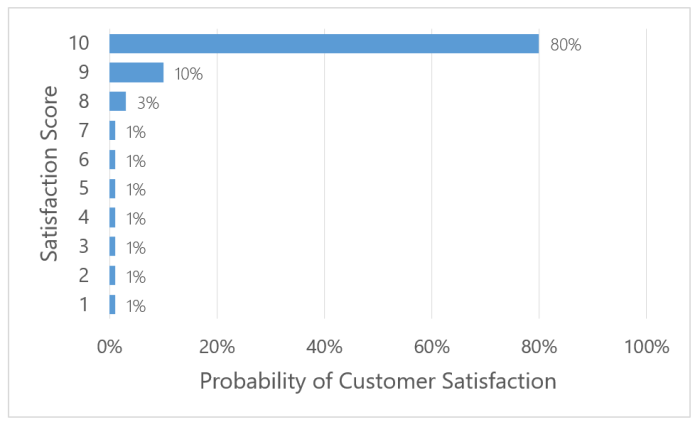
To think about the impact of cross-touchpoint experience management more fully I ran a simulation in R. I imagined there was a company that had 10,000 customers they were onboarding over the course of a year with 19 various touchpoints. To make the simulation more realistic I shifted from the binary “satisfied/unsatisfied” calculation above and imagined the satisfaction score distribution for each touchpoint show below. For most companies this would be a highly successful customer management program. And indeed, after running 1,000 simulations the average customer score is a 9.4 (which is just the expected value using the distribution below).

…but because there are so many customers and the probabilities of each touchpoint are independent 5.5% of customers ended up having two or more touchpoints they rated as a two or below. Nearly a quarter (24.5%) of customers had two or more touchpoints that were rated a five or below.

probs.PNG

This could have drastic consequences for revenue. Two or more horrible touchpoint experiences during the onboarding process — which is obviously the first impression a customer has with a particular company — could lead customers to reduce the amount of service they buy or to abandonment altogether.

One way to think about fixing the problem of the customer journey is to envision transforming independent probabilities into conditional probabilities. So, for example, if a customer does experience a particularly bad touchpoint the conditional probability that their subsequent touchpoints will be managed with special diligence should increase.

From an O-ring point of view the answer is simple: ensure that you are creating agglomeration economies that attract high-performing individuals that help construct great teams. Groups of people that are operating together at a high-level inspire one another and hold one another accountable, creating a virtuous circle. Over time the natural effect is to weed out low performers. Great teams might reduce the probability of a poor experience from 5% to 0.5%.

Of course to perform at their maximum level teams need to be well trained and know what mark to shoot for. This is just the solution the authors helped the TV provider narrow in on.

The authors conclude that:

As company leaders dug further, they uncovered the root of the problem. Most customers weren’t fed up with any one phone call, field visit, or other interaction—in fact, they didn’t much care about those singular touchpoints. What reduced satisfaction was something few companies manage—cumulative experiences across multiple touchpoints and in multiple channels over time.

The pay TV company’s salespeople, for example, were focused on closing new sales and helping the customer choose from a dense menu of technology and programming options—but they had very little visibility into what happened after they hung up the phone, other than whether or not the customer went through with the installation. Confusion about promotions and questions about the installation process, hardware options, and channel lineups often caused dissatisfaction later in the process and drove queries to the call centers, but sales agents seldom got the feedback that could have helped them adjust their initial approach.

The solution to broken service-delivery chains isn’t to replace touchpoint management. Functional groups have important expertise, and touchpoints will continue to be invaluable sources of insight, particularly in the fast-changing digital arena. (See David Edelman’s“Branding in the Digital Age: You’re Spending Your Money in All the Wrong Places,” HBR December 2010.) Instead, companies need to embed customer journeys into their operating models in four ways: They must identify the journeys in which they need to excel, understand how they are currently performing in each, build cross-functional processes to redesign and support those journeys, and institute cultural change and continuous improvement to sustain the initiatives at scale.


R code below:

###################################################################################################
# James McCammon
# Customer Experience Simulation
# 6/25/2016
# Version 1.0
###################################################################################################
 
# Function to get the number of customers with a certain number of ratings below a given threashold
percent_x_scores_below_y = function(sim, num_scores, equal_or_below_cutoff, num_customers) {
  (sum(apply(sim,2,FUN=function(x) sum(x<=equal_or_below_cutoff)) >= num_scores)/num_customers) * 100 
}
 
# Set variables
scale = 1:10
probs = c(.01, .01, .01, .01, .01, .01, .01, .03, .1, .8)
interactions.per.customer = 19
num_customers = 10000
n = interactions.per.customer*num_customers
num_sims = 1000
 
# Setup results matrix
sim_results = matrix(nrow=num_sims, ncol = 3)
colnames(sim_results) = c('Average_Customer_Rating',
                       'Percent_Having_Two_Scores_Below_Two',
                       'Percent_Having_Two_Scores_Below_Five')
 
# Run simulation
for(i in 1: num_sims) {
  # Run sim
  sim = matrix(sample(scale, size=n, replace=TRUE, prob=probs), ncol=num_customers, nrow=interactions.per.customer)
  # Store mean score
  sim_results[i,'Average_Customer_Rating'] = mean(apply(sim,2,mean))
  # Store % of customers with two scores below 2
  sim_results[i,'Percent_Having_Two_Scores_Below_Two'] = percent_x_scores_below_y(sim, num_scores=2, equal_or_below_cutoff=2, num_customers)
  # Store % of customers with two scores below 5
  sim_results[i,'Percent_Having_Two_Scores_Below_Five'] = percent_x_scores_below_y(sim, num_scores=2, equal_or_below_cutoff=5, num_customers)  
}
 
# Calculate average across sims
apply(sim_results, 2, mean)

Created by Pretty R at inside-R.org